
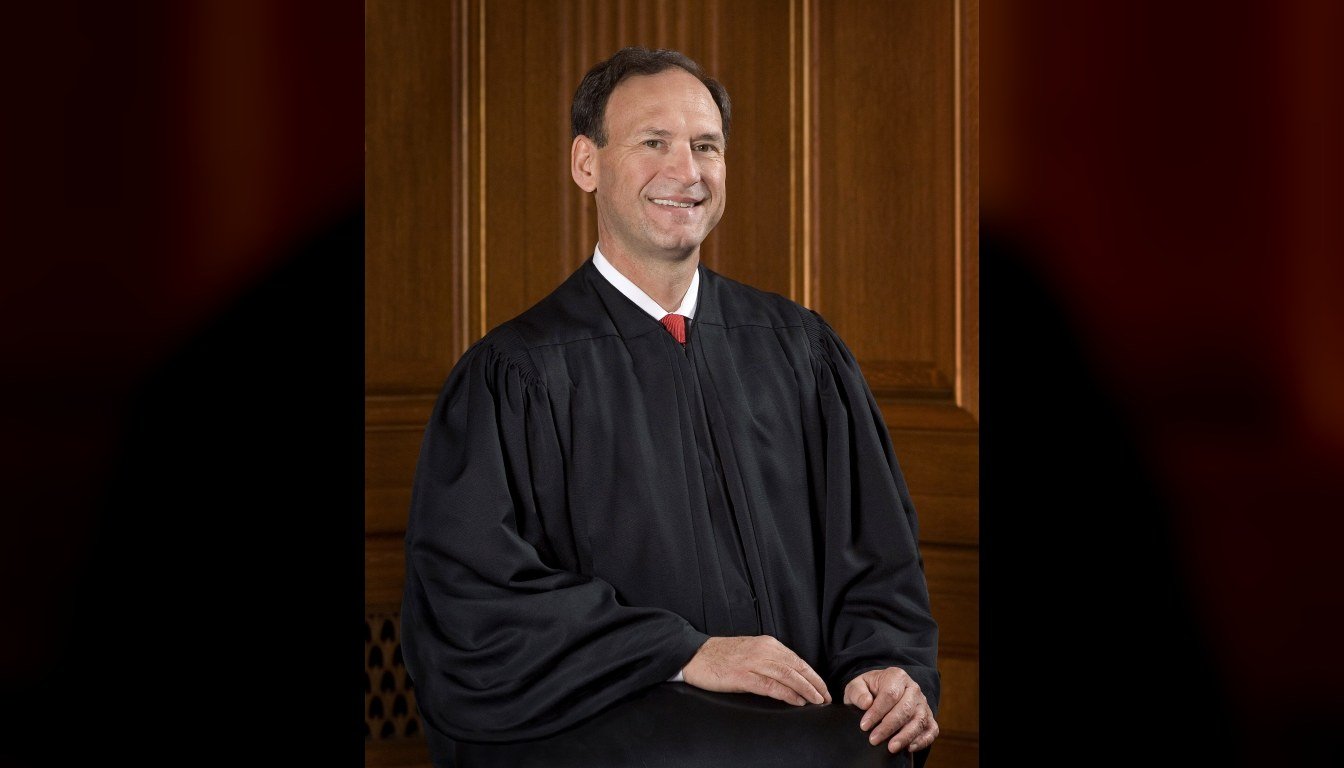
Supreme Court Justice Samuel Alito warned on Thursday night that Congress could "turn off the lights" at the Supreme Court by refusing to fund it. He spoke at a Federalist Society dinner in Washington, D.C.
His remarks came days after Democrats won control of both the House and the Senate in larger-than-expected numbers, according to NBC News. Alito did not directly mention the midterm elections, but his comments put the court's budget at the center of a question that the incoming Congress will face.
What Alito said about Congress and Supreme Court funding
Alito spoke in conversation with the conservative author Mollie Hemingway at a black-tie dinner for the Federalist Society's National Lawyers Convention, NBC reported. HuffPost and the New York Post called the event the Antonin Scalia Memorial Dinner.
"Congress can turn off the lights of the Supreme Court and stop everything from happening if they will not fund their activities," Alito said, according to NBC News. He added that Congress has "many, many, many other things" it can do, or at least try to do.
Alito said the judiciary is the least powerful branch and is "vulnerable to the executive and to Congress because they are more powerful," NBC reported. The New York Post noted that the Constitution protects justices from salary cuts while they remain in office. Congress, however, controls the court's appropriations and can influence funding for its staff, operations and facilities.
The New York Post also reported that Democrats have floated expanding the number of justices, imposing term limits and adopting stricter ethics requirements. Some liberal lawmakers have suggested using Congress's spending power to press the court toward reforms. Alito's remarks did not name any of those proposals.
The research does not show that any member of the incoming Congress has proposed or scheduled a funding cut for the court. Alito spoke about what Congress could do, not about a bill.
Alito's criticism of lower-court judges and Trump-era orders
Alito also said some federal judges had gone too far in recent orders, which he called "unjustified orders," according to NBC News. HuffPost reported that he criticized lower-court judges for blocking presidential policies in recent years.
Alito said presidents frustrated by Congress have looked for ways to act unilaterally. Opponents then rush to court to block those actions, he said, NBC reported. He argued that this dynamic helped drive the rise of the emergency docket over the past 10 or 15 years.
NBC described the emergency docket as the "shadow docket." It reported that the Trump administration has had a very high success rate with the conservative majority on interim rulings. Those rulings have allowed the administration to proceed with immigration enforcement, the restructuring of the federal government and construction of a White House ballroom while underlying litigation is pending.
Alito also said judges are dedicated and skillful but not perfect, and that they make mistakes. HuffPost quoted him: "They are dedicated and they are skillful, but they're not perfect and they make mistakes."
Retirement plans and what remains unknown
HuffPost reported that Alito, 76, and Justice Clarence Thomas, 78, both said before the current term that they do not plan to retire even if Democrats win the Senate. HuffPost wrote that this has raised Republican worries that their seats might not be filled under a Republican president and Senate.
The Federalist Society says it does not take official positions, HuffPost reported. The group has long been a pipeline for Republican judicial nominees, including several sitting justices.
NBC put the audience at more than 2,500 conservative elected officials, lawyers, judges and advocates. HuffPost put it at more than 1,000 conservative lawyers. The two outlets' figures differ, and the research does not resolve the discrepancy.
Reports from NBC, HuffPost and the New York Post do not include any response to Alito's remarks from Democratic leaders, the White House or the court itself. It is not yet known whether any lawmaker will move to test his warning with a funding proposal.