

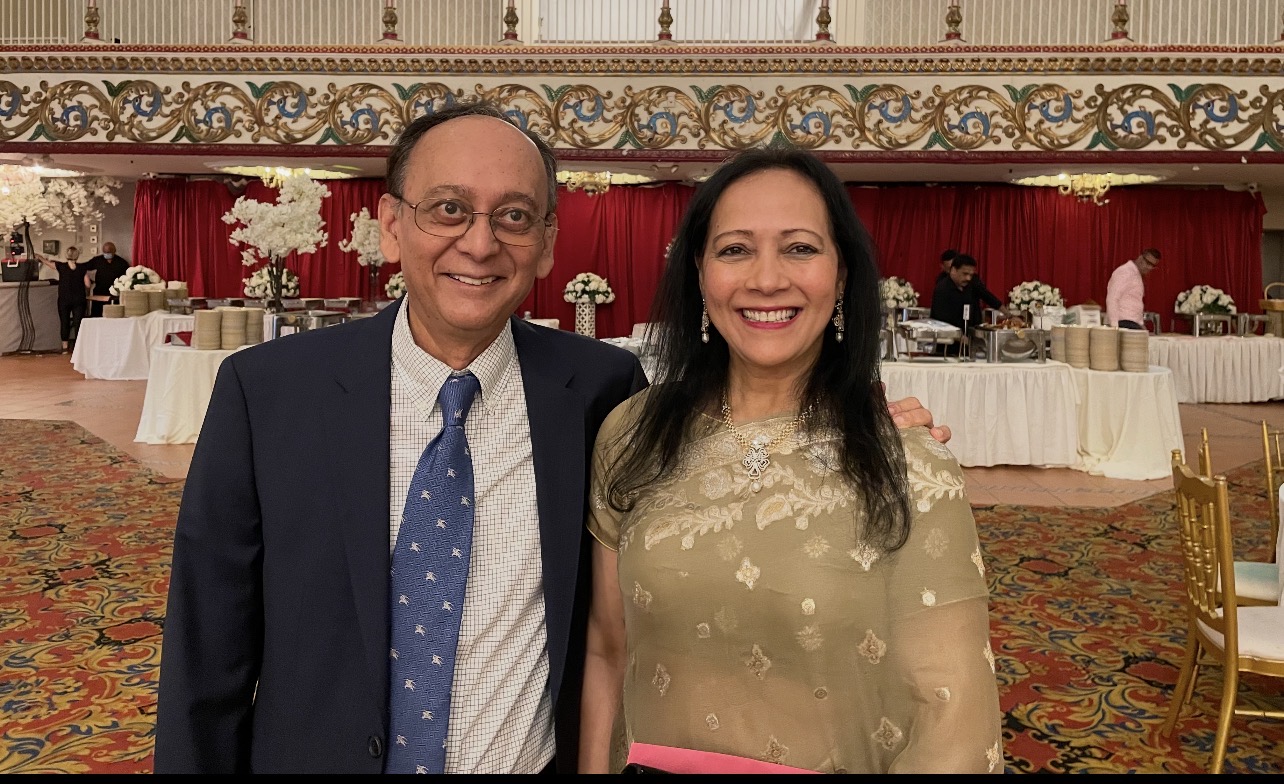
By Al Mamun
Born on March 27, 1953, in the port city of Chittagong, Dr. Mahbub Hoque emerged from humble beginnings to become one of the most accomplished Bangladeshi-American scientists in the field of electrical engineering and communications technology. His decades-long career spanning academia, telecommunications, and advanced military communications research has earned him international recognition, including the prestigious distinction of IEEE Fellow.
Dr. Hoque was the eldest son of Mrs. Farida Begum and Mr. Hafiz Ahmed. From an early age, he demonstrated exceptional academic talent. He studied at several renowned educational institutions in Chittagong, including St. Placid's School, the Primary Training Institute School, and Muslim High School, later graduating from Collegiate High School in 1968.
Following his secondary education, he moved to Dhaka to pursue higher studies. He was admitted to both the University of Dhaka and the Bangladesh University of Engineering and Technology (BUET). Choosing the latter, he enrolled in the Department of Electrical Engineering and graduated from BUET in 1976 as part of the 1974 batch. He earned distinction with honors by achieving above 75 percent marks—a rare academic accomplishment during that period.
Dr. Hoque married Nasima Hoque (Hashi) in 1979. They are blessed with two children, Sagor Hoque and Nabila Hoque. Sagor Hoque is married to Dr. Salma Siddique, and they have two daughters, Alia Hoque and Layna Hoque. Nabila Hoque is married to Rahil Esmail, and they have two sons, Sufiyan Hoque Esmail and Zain Hoque Esmail.
Recognizing his outstanding academic performance and technical brilliance, BUET appointed him as a faculty member shortly after graduation. In 1979, Dr. Hoque received the prestigious Commonwealth Scholarship and traveled to the United Kingdom to pursue advanced research in electromagnetics. He successfully completed his Ph.D. in Electrical Engineering in 1983 from University College London, specializing in electromagnetics and antennas, and later returned to Bangladesh to continue serving as a faculty member at BUET, contributing to the development of engineering education and research.
Dr. Hoque’s international career expanded rapidly. He later joined the University of Utah in the United States, where he initially worked as a faculty member and was promoted to a research faculty position within six months due to his innovative work and leadership in communications engineering.
His expertise in telecommunications and electromagnetic systems attracted the attention of Bellcore, one of America’s leading telecommunications research organizations at the time. Serving as a Director at Bellcore & Telcordia Technologies, Dr. Hoque made major contributions to signal interference prediction and communication technologies. His groundbreaking work in analyzing and developing a novel interference prediction technique regarding the impacts of radio interference during the deployment of ADSL systems in New York City reportedly saved millions of dollars for telecommunications providers. In recognition of these achievements, he received Bellcore’s prestigious Presidential Recognition Award in 1996.
In 2000, Dr. Hoque joined the Space & Terrestrial Communications Directorate (S&TCD) of the United States Army’s Communications-Electronics Research, Development and Engineering Center (CERDEC), located at Aberdeen Proving Ground, Maryland. He served the organization for nearly 24 years. Beginning as a Team Lead, he steadily rose through the ranks to take on major leadership roles. From June 2007 to June 2013, he simultaneously served as the Chief Scientist of S&TCD, and from June 2012 to January 2013, he also served as the Acting Director of the Directorate. He later served as the Branch Chief and Division Chief of the Radio Frequency Communications Division.
During his tenure as Chief Scientist, Dr. Hoque led S&TCD’s basic research program. This encompassed critical technology areas such as network science, nanotechnologies, software-defined radios, network operations, modeling and simulation, tactical and strategic satellite communications, information assurance, antennas, electromagnetic interference/electromagnetic compatibility, spectrum management, and evolutionary commercial wireless technologies.
As Division Chief, Dr. Hoque led a workforce of over 100 dedicated personnel providing engineering solutions in spectrum management and electromagnetics. Under his leadership, the division operated in vital areas including metamaterial research and development, the mitigation of coupling issues between collocated antennas, and the creation of advanced spectrum architectures and cognitive networks. Over his prolific career, he authored more than 70 publications and chaired numerous sessions at various national and international engineering conferences and symposiums.
According to CERDEC, Dr. Hoque played a pivotal role in developing innovative antennas and advanced tactical communication technologies that significantly enhanced battlefield communications and helped protect soldiers during military operations. His work on low-cost beam-switching antenna technology and radio-frequency modeling became highly influential in modern tactical communications systems.
In 2016, Dr. Hoque achieved one of the highest honors in the engineering profession when he was named an IEEE Fellow by the Institute of Electrical and Electronics Engineers—the world’s largest professional association dedicated to advancing technology. The IEEE Fellow distinction is awarded to individuals with extraordinary accomplishments and is considered one of the most prestigious recognitions in engineering and technology worldwide.
The U.S. Army recognized Dr. Hoque’s contributions with several distinguished honors, including both the Commander's Award for Civilian Service and the Superior Civilian Service Award, acknowledging his decades of groundbreaking research and organizational leadership.
Over a career spanning more than three decades, Dr. Mahbub Hoque has established himself as a pioneering engineer, respected scientist, and inspirational figure for Bangladeshi professionals around the world. From the classrooms of Chittagong and Dhaka to the highest levels of American scientific and defense research, his journey reflects dedication, innovation, and excellence on the global stage.