
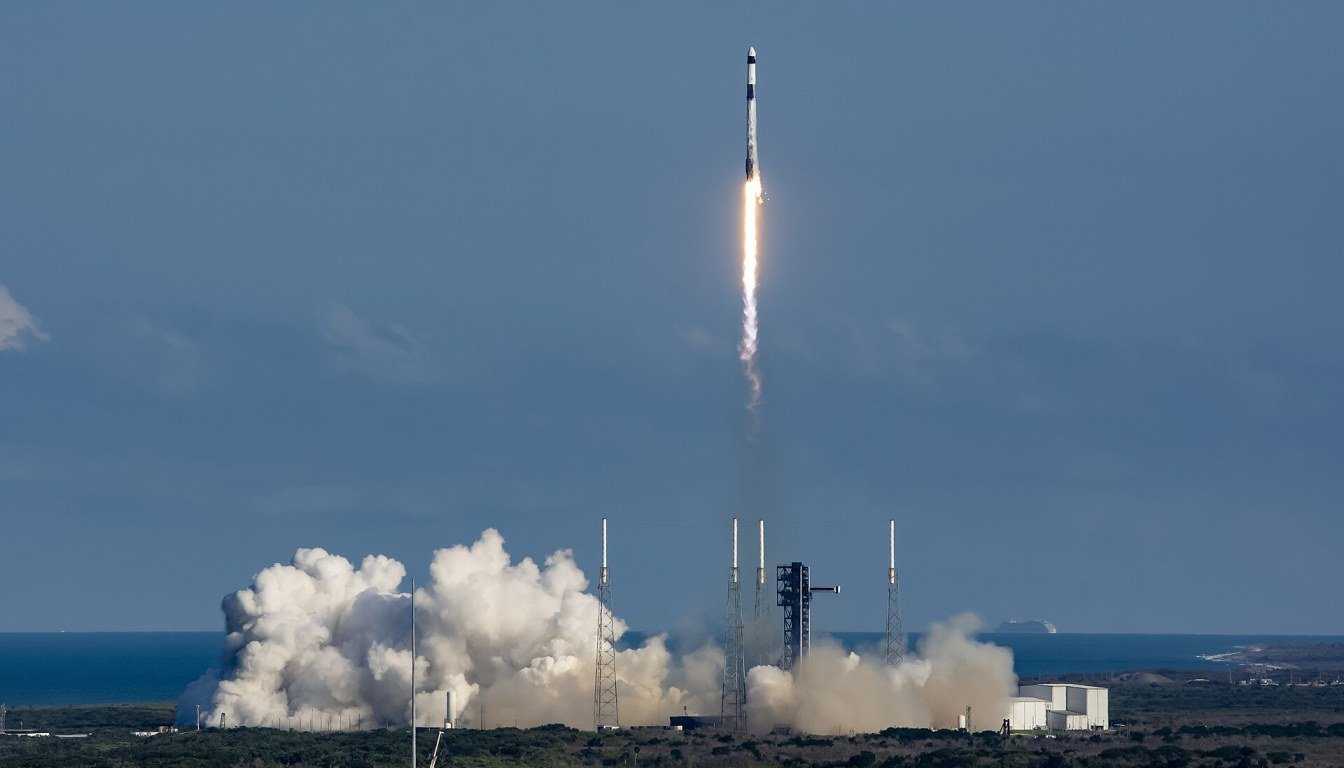
A United Launch Alliance Vulcan rocket suffered a mission-ending malfunction about 10 minutes after liftoff on the afternoon of November 15, destroying its payload of Amazon Leo broadband satellites, according to Scientific American.
The loss is the first total mission failure for ULA, a joint Boeing–Lockheed Martin venture. It is also a setback for Amazon, the US Space Force and NASA, all of which depend on Vulcan to reach orbit.
What happened after Vulcan lifted off from Cape Canaveral?
The flight was Vulcan's return to flight after a February launch that had worrisome malfunctions in a Northrop Grumman-made solid rocket booster. It lifted off from Space Launch Complex 41 at Cape Canaveral Space Force Station in Florida on a Sunday.
It was the first Vulcan launch to use six solid rocket boosters, rather than two or four. According to Scientific American, the boosters showed no obvious problems and peeled off about one and a half minutes into flight, as planned.
About five minutes after takeoff, the first stage, powered by BE-4 engines, fired 30 seconds longer than planned. "That's a long time, because in launches, everything is timed to the second," said Paul Ronney, an aerospace engineer at the University of Southern California. He told Scientific American that the timing suggests the first stage underperformed and had to keep firing to compensate.
Why did the Vulcan rocket fail?
The root cause has not been confirmed. A ULA statement posted on its website on November 17 said, "Early indications are that just after liftoff the launch vehicle experienced low [first-stage] performance," causing stage separation low in altitude and below the minimal velocity needed to reach orbit. The statement was reproduced in a republished copy of the Scientific American report on Yahoo Tech.
Julie Arnold, a ULA spokesperson, told Scientific American: "Today we did not meet that standard." She said the company exists to provide assured access to space for the nation and its customers.
Which Amazon Leo satellites were lost, and what happens to the rollout?
The lost payload was a set of satellites for Amazon Leo, Amazon's broadband internet service. Scientific American reported that the service is already far behind schedule, and that Amazon had booked 37 more Vulcan launches to deliver more of its satellites.
The research does not say how the failure will affect those 37 launches or the rollout timetable. Amazon's plans for the remaining flights are therefore unclear.
Who makes the BE-4 engine used on Vulcan and New Glenn?
Blue Origin supplies the BE-4 engines that power Vulcan's first stage. According to Scientific American, the same engine is used on Blue Origin's New Glenn rocket, which blew up during a launchpad test in May and remains grounded. Company officials are targeting January 2027 for its return to flight.
A Blue Origin spokesperson told Scientific American that the company "is working closely with ULA to investigate and determine the root cause." Whether the BE-4 engines caused the failure has not been established.
If they did, Scientific American reported, the failure could compound delays for Blue Origin's Blue Moon lunar lander. NASA needs that lander for its Artemis moon landings, and it must launch on New Glenn.
Does the Vulcan failure affect NASA's Artemis moon mission?
Vulcan's second stage, the Centaur V, is also integral to future flights of NASA's Space Launch System rocket, which supports Artemis. Scientific American reported that significant problems with the Centaur V could lead to more delays for future SLS launches.
According to the Yahoo Tech copy of the Scientific American report, NASA chief Jared Isaacman expressed support for the investigation in a response on X. The failure may also affect NASA's race against China to land astronauts on the moon and build a base there.
The investigation into the first-stage performance is ongoing, and ULA has not said when Vulcan will fly again.