

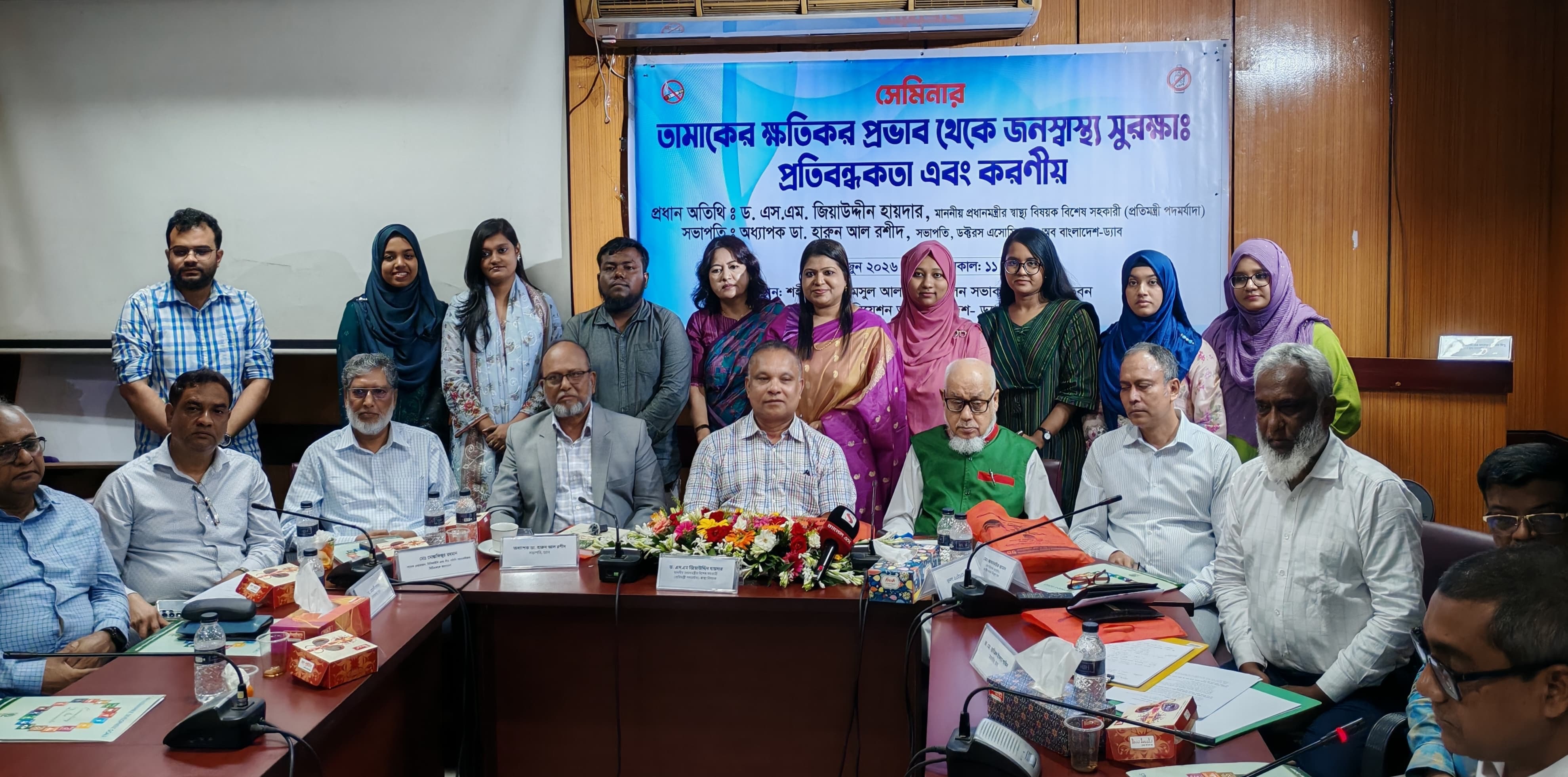
Dhaka, June 24, 2026: The government remains firmly committed to implementing effective tobacco control measures, including increasing the prices of tobacco products in the national budget, to safeguard public health and protect future generations from the harmful effects of tobacco and nicotine, according to Dr. S. M. Ziauddin Haider, Special Assistant to the Prime Minister on Health Affairs.
Speaking at a seminar titled “Protecting Public Health from the Harmful Effects of Tobacco: Challenges and Way Forward” held at the BMA Auditorium in Dhaka on Wednesday, Dr. Haider said tobacco control and public health protection were among the major commitments outlined in the government’s election manifesto.
He noted that on the occasion of World No Tobacco Day, Prime Minister Tarique Rahman reaffirmed the government’s strong commitment to shielding children, adolescents, and future generations from the dangers of tobacco and nicotine addiction. Dr. Haider emphasized that the period leading up to the finalization of the FY 2026–27 national budget presents a crucial opportunity to introduce stronger public health measures through effective tobacco taxation policies.
The seminar was jointly organized by the Doctors Association of Bangladesh (DAB) and the Development Organisation of the Rural Poor (DORP).
Presenting the keynote paper, Zeba Afroza highlighted recommendations from public health and tobacco control experts to simplify Bangladesh’s cigarette taxation system by reducing the current four-tier pricing structure to three tiers. She explained that the small price difference between low- and medium-tier cigarettes allows smokers to switch to cheaper alternatives whenever taxes increase.
To address this issue, experts proposed merging the low- and medium-tier categories and setting the retail price of a 10-stick cigarette pack at BDT 100. They also recommended maintaining the existing 67 percent supplementary duty on all cigarette categories while introducing a specific tax of BDT 4 per 10-stick pack.
According to Afroza, implementing these measures would significantly reduce the affordability of tobacco products, particularly among young people, and discourage smoking initiation.
Dr. Shafiun Nahin, Director of the Institute of Health Economics at the University of Dhaka, criticized the proposed FY 2026–27 budget for introducing only a marginal increase in cigarette prices. He pointed out that the price of a 10-stick pack of low-tier cigarettes has risen from BDT 60 to only BDT 62, despite nearly 75 percent of cigarettes sold in Bangladesh belonging to this category.
“An increase of only BDT 2 per pack is insufficient to discourage tobacco consumption, especially at a time when inflation remains above nine percent,” he said.
Dr. Nahin further explained that while the proposed budget sets the retail price of low-tier cigarettes at BDT 6.2 per stick, such cigarettes are already selling for around BDT 7 per stick in retail markets. As a result, tobacco companies could gain an additional untaxed profit of approximately BDT 0.8 per cigarette.
Citing official sales figures, he said Bangladesh sold approximately 68.89 billion low-tier cigarettes during the 2023–24 fiscal year. Based on the additional profit margin, tobacco companies could earn around BDT 55.12 billion (BDT 5,512 crore) in extra profits, representing a significant loss of potential tax revenue for the government.
Speakers at the seminar welcomed recent amendments to the country’s tobacco control law and expressed optimism that the government would continue to strengthen tobacco control policies in line with its election commitments.
As lead discussant, Dr. Md. Zahirul Islam, Secretary General of DAB, expressed concern over the proposed taxation of nicotine pouches, nicotine granules, and Heated Tobacco Products (HTPs). He warned that imposing taxes on these products could unintentionally legitimize them in the market and encourage their expansion, increasing the risk of nicotine addiction among young people and adolescents.
Professor Dr. Harun Al Rashid, President of DAB, reiterated the organization’s commitment to collaborating with DORP on long-term tobacco control initiatives and urged the government to reconsider the tax and pricing structure of low-tier cigarettes and smokeless tobacco products in the upcoming budget.
He stated that implementing the recommendations put forward by public health experts could generate approximately BDT 44 billion in additional government revenue while encouraging nearly 500,000 adult smokers to quit. Additionally, around 372,000 young people could be prevented from taking up smoking and nearly 400,000 premature deaths could be avoided over the long term.
The seminar was inaugurated with welcome remarks by AHM Noman, Founder and CEO of DORP, and moderated by Mohammad Zobair Hasan, Deputy Executive Director of the organization.
Among those attending the event were public health experts, members of DAB, representatives from civil society organizations, and youth advocates, including representatives from Dhaka Ahsania Mission and the National Heart Foundation Hospital and Research Institute.