

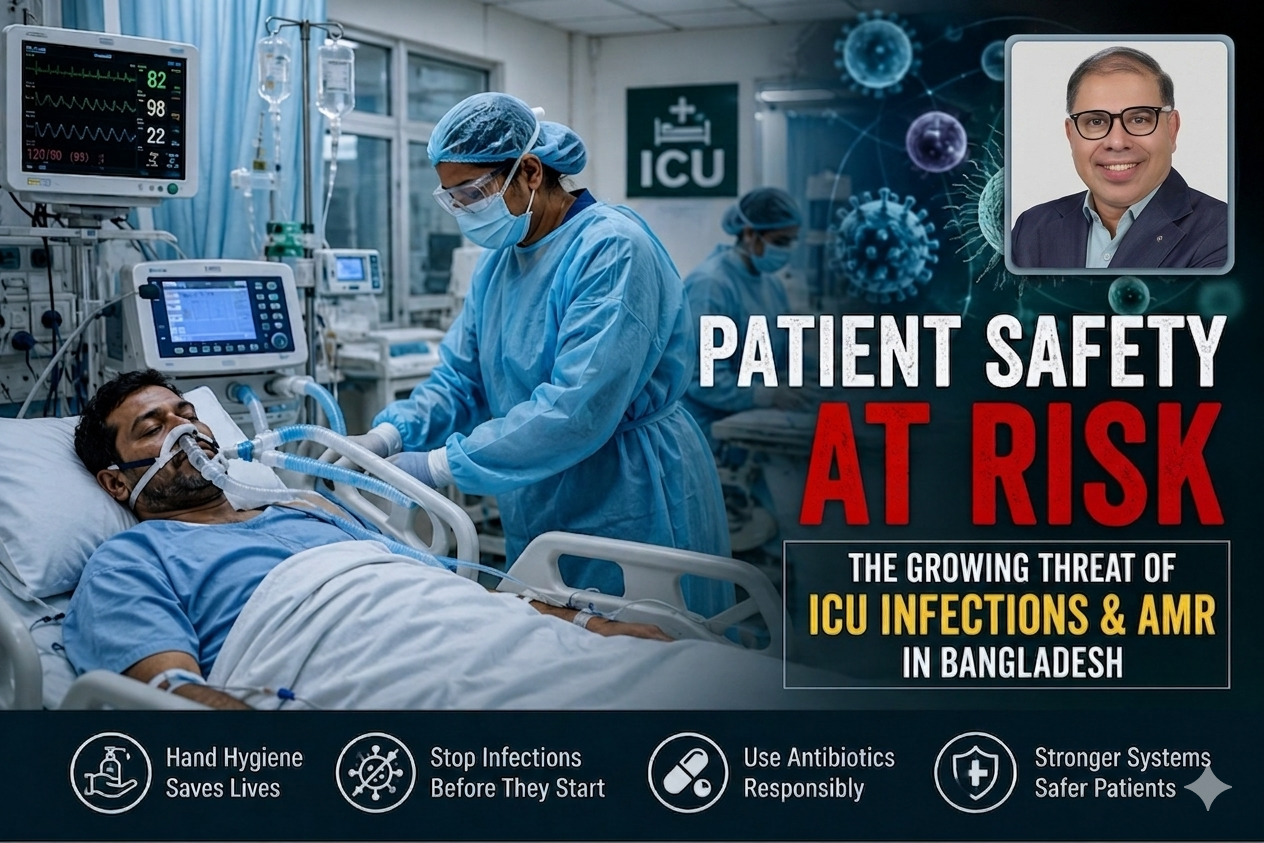
Over the past decade, Bangladesh has experienced rapid growth in modern hospitals, advanced medical technology, and intensive care units (ICUs). Large public and private hospitals now offer ventilators, advanced surgeries, digital monitoring systems, and specialized critical care services.
On the surface, the healthcare sector appears to be progressing. However, behind this visible development lies a serious and growing crisis: patient safety, infection control, antibiotic management, and accountability remain dangerously weak.
In many cases, ICUs — which are meant to represent the last hope for saving lives — are slowly becoming silent threads on patient safety.
Hospital-Acquired Infections (HAIs) have become a major global public health challenge. Patients admitted to ICUs are particularly vulnerable because they often require ventilators, catheters, invasive procedures, and prolonged hospitalization. While these interventions are lifesaving, they can also become sources of dangerous infections when proper infection prevention measures are not maintained.
Ventilator-Associated Pneumonia (VAP), catheter-related bloodstream infections, urinary tract infections, and sepsis are increasingly common in many hospitals. In severe cases, these infections can lead to septic shock, organ failure, and death.
The most alarming reality is this: many patients are no longer dying solely from their original illness — they are dying from infections acquired inside hospitals.
The situation has become even more dangerous because of the rapid spread of Multi-Drug-Resistant Organisms (MDROs). Bacteria such as Acinetobacter baumannii, Klebsiella pneumoniae, and Pseudomonas aeruginosa are now showing resistance to many powerful antibiotics. As a result, treatment becomes more complicated, expensive, and sometimes ineffective.
The World Health Organization (WHO) has already identified Antimicrobial Resistance (AMR) as a ‘silent pandemic.’ Globally, millions of people are affected by resistant infections every year. Since the COVID-19 pandemic, ICU-based resistant infections have increased further in many countries.
According to the Global Research on Antimicrobial Resistance (GRAM) Project, AMR was directly responsible for approximately 1.14 million deaths worldwide in 2021. Experts now project nearly 39 million AMR-related deaths between 2025 and 2050 if urgent action is not taken.
South Asia — particularly Bangladesh, India, and Pakistan — is considered one of the highest-risk regions for AMR. Research from tertiary hospitals in Bangladesh shows high rates of multidrug-resistant infections, especially in ICUs. Some studies report extremely high rates of carbapenem resistance among Acinetobacter species, along with rising cases of ventilator-associated pneumonia and sepsis.
Research also shows that HAIs rates in low- and middle-income countries are significantly higher than those in high-income countries. A recent meta-analysis reported an overall HAI prevalence of around 22%, while the WHO South-East Asia region showed rates as high as 37%. In some low-resource settings, up to one in three ICU patients may acquire a hospital-associated infection.
Several interconnected factors are driving this crisis in Bangladesh.
Unnecessary antibiotic use remains one of the biggest problems. Many people buy antibiotics directly from pharmacies without a prescription, while others stop taking their medication before completing the full course. Strong antibiotics are often used unnecessarily for common viral illnesses such as colds and influenza.
Bangladesh is already facing a severe AMR crisis. Research estimates that approximately 26,000 deaths in Bangladesh were associated with antimicrobial resistance in 2019 alone. Recent hospital studies in Dhaka found that nearly 75% of ICU-related bacterial isolates were multidrug-resistant (MDR), and some organisms were resistant to nearly all available antibiotics except colistin.
This ‘over-the-counter antibiotic culture’ is helping bacteria become stronger and more resistant.
Studies have shown that more than 90% of surveyed community pharmacies in Bangladesh dispense antibiotics without a prescription. Reports also estimate that nearly 15 million people may be taking antibiotics daily without proper medical supervision.
At the same time, infection prevention systems in many hospitals remain weak. Poor hand hygiene practices, overcrowded wards, limited ICU staffing, inadequate infection control training, and weak laboratory surveillance make it difficult to control the spread of infections.
The excessive use of antibiotics in livestock, poultry, fisheries, and agriculture is also contributing to the growing problem of antibiotic resistance. A nationwide study in Bangladesh identified Carbapenem-resistant Enterobacterales (CRE) in approximately 12.5% of tested samples, with the highest rates among newborns and elderly patients. Carbapenems are considered among the last-line antibiotics for severe infections, making this trend deeply alarming.
Resistant bacteria are now spreading through food systems, the environment, hospitals, and communities. This is no longer solely a medical issue; it is a major threat to public health, human security, healthcare systems, and national economies.
The world is gradually moving toward what experts call the “Post-Antibiotic Era” — a future in which common infections, minor surgeries, and routine medical procedures could once again become life-threatening because effective antibiotics no longer work.
So, what should Bangladesh do now?
First, the country needs a robust National AMR Surveillance System to regularly monitor trends in resistant bacteria and infections across hospitals and communities.
Second, every hospital and ICU should implement mandatory Antimicrobial Stewardship Programs to ensure responsible antibiotic use.
Third, Infection Prevention and Control (IPC) systems must be strengthened. Proper hand hygiene, sterilization, safe ventilator and catheter management, regular ICU audits, and infection monitoring should become mandatory.
Fourth, prescription-only antibiotic policies must be strictly enforced to stop unnecessary and uncontrolled antibiotic use.
Fifth, hospitals need continuous training programs for doctors, nurses, and healthcare workers.
Bangladesh has talented healthcare professionals, skilled physicians, and a growing medical infrastructure. However, without patient safety and accountability, healthcare development alone is not enough. At the same time, hospitals should develop a culture of transparency, patient safety, and Root Cause Analysis (RCA) after major adverse events.
Antibiotic misuse is not limited to hospitals. Research in Bangladesh has found high levels of antibiotic resistance in livestock and poultry-related food systems, including significant resistance to commonly used antibiotics such as tetracycline. This highlights the growing need for a coordinated “One Health” response connecting human, animal, and environmental health.
Global health experts also emphasize the importance of the 'One Health Approach,' which recognizes the interconnections among human health, animal health, agriculture, and the environment in combating antimicrobial resistance.
Experts warn that South Asia may carry the world’s highest future burden of AMR-related deaths over the coming decades unless major improvements are made in infection prevention, antibiotic stewardship, and healthcare governance.
Healthcare is built on trust. Protecting that trust is the moral responsibility of hospitals, healthcare professionals, policymakers, and government authorities. The time for action is now. Otherwise, many ICUs may continue to function not as places of healing, but as silent threats hidden behind modern hospital walls.
Join our facebook page: (Click Below) https://www.facebook.com/share/1Cc6EyQXue/?mibextid=wwXIfr