

Editorial | Written by: Al Mamun
Whenever incidents of child rape and sexual abuse surface in Bangladesh, intense outrage grips society. Many ask— "How can people be so brutal?", "Did this happen before, or is it increasing now?", "Would we even know about it if social media didn’t exist?"
According to experts, child rape is not just a crime; it is a complex intersection of the abuse of power, a distorted mindset, social failure, and weak law enforcement. The World Health Organization (WHO), UNICEF, and various research studies indicate that a large portion of child sexual abuse remains hidden in secrecy for a long time.
Psychologists state that many offenders target children not for sexual gratification, but rather from a mindset of controlling and intimidating someone vulnerable. Children cannot easily protest, making them "easy targets."
According to data from the US CDC, in nearly 90 percent of child sexual abuse cases, the perpetrator is someone known to the child—a relative, neighbor, teacher, religious figure, or someone close to the family.
On the other hand, the WHO notes that a portion of individuals who experienced violence or abuse during their own childhood may later engage in violent behavior themselves. Although not all victims become perpetrators, untreated trauma creates a major risk.
Experts believe that unregulated pornography, child abuse content, and the spread of sexual perversion on social media are influencing the behavior of some individuals. UNICEF has warned that the internet has opened new avenues for the sexual exploitation of children.
In Bangladesh, many families hide complaints, thinking that their "honor will be ruined." As a result, perpetrators get repeated opportunities.
Discussions on social media have also repeatedly highlighted that many incidents never reach police stations, nor do they appear in the news media.
Many highly-publicized cases also hang in limbo year after year. This reduces fear among criminals. This is also a major reason for the frustration and anger of ordinary people on social media.
Did these things not happen before?
According to experts and researchers, the notion that "it happened less before" is not entirely correct. Rather, in the past, most incidents were suppressed.
The reasons were: Social media did not exist, Online news media was limited, Families did not speak out due to shame and social pressure, Children’s voices were not taken seriously, Cases were often not filed even when reported to the police station.
Both the WHO and UNICEF state that a large portion of child abuse remains a "hidden crime" or an invisible offense. That is, the actual numbers could be much higher than the published figures.
Today, due to social media, many incidents quickly go viral. As a result, people now know more. However, this does not mean that the crime is new; rather, visibility has increased.
According to analysts, several factors are making the situation dire: Unsafe online usage by children, Lack of adequate parental supervision, Drugs and criminal syndicates, Impunity for politically or socially influential people, Social taboos regarding sex education, Not teaching children how to say "no", and a culture of "settling" crimes outside of court.
What Parents and Society Need to Do
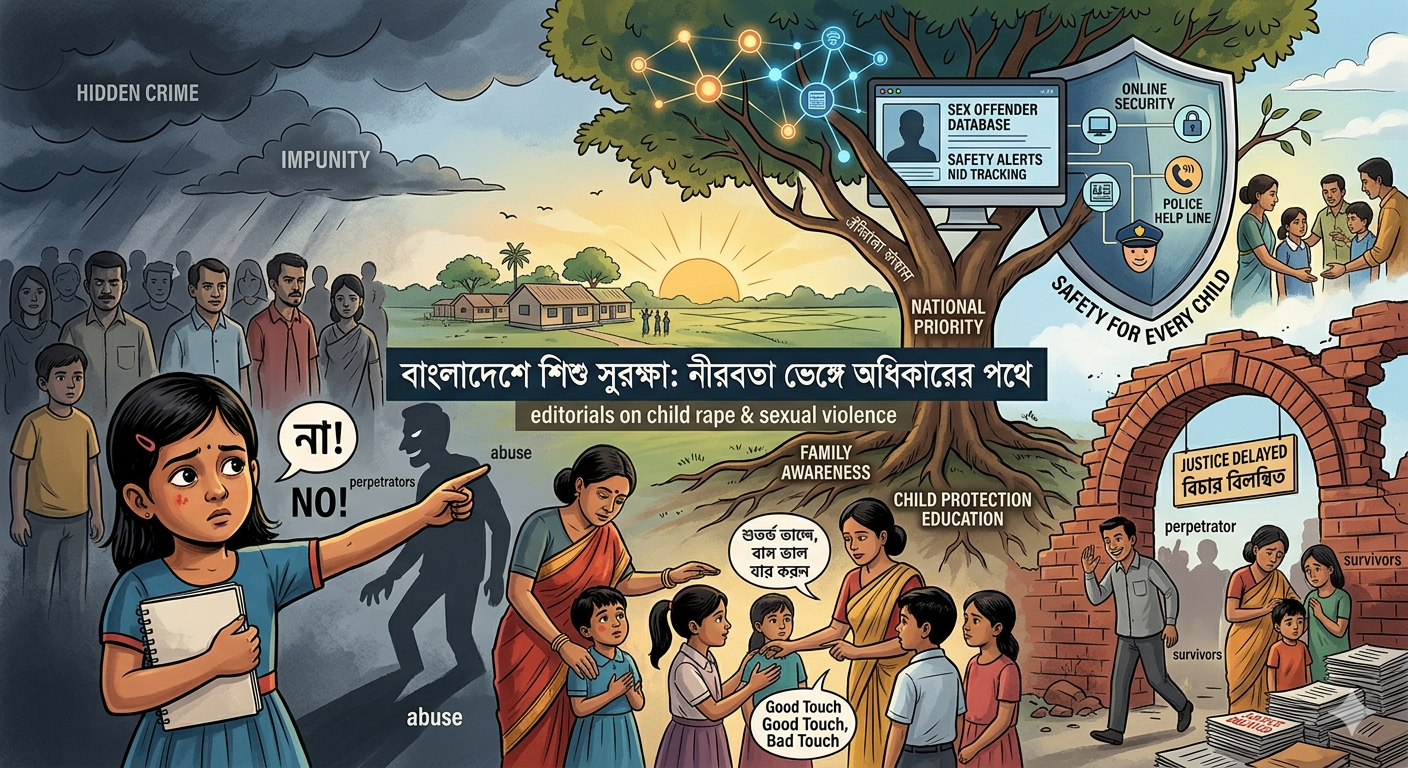
Parents have a lot to do to protect their children. Teaching a child about "good touch–bad touch" is no longer a luxury; it is a necessity. Children must be taught from an early age which parts of the body are private and to say "no" if anyone touches them.
If a child suddenly becomes quiet, looks scared, or changes their behavior—it must be taken seriously. Many children fear that "if I tell, my parents will get angry." Therefore, children must be provided with an environment where they can openly share any uncomfortable incident.
We must also break away from blind faith like "he is a relative" or "he is a teacher." This is because most abuse occurs through familiar people.
Child protection education needs to be made compulsory in schools, madrasas, mosques, and clubs. At the same time, online safety, cyber monitoring, and accessible, effective helplines for children must be launched.
Parents must keep an eye on their child’s online activities. They need to be aware of what videos their children are watching, who they are talking to, which apps they are using, and whether any strangers are contacting them.
Changes in children's behavior must also be observed. Parents should check if the child has suddenly become withdrawn, looks frightened, is having trouble sleeping, is avoiding a specific person, or is throwing unusual tantrums or crying. These can be signs of trauma.
Not just families—schools, mosques, clubs, and local communities—everyone needs to be trained in child protection.
Experts say that strict punishment alone is not enough. What is needed is: Speedy trials, Mandatory child protection education, Counseling services, Online safety measures, Helplines for children, A database of sex offenders, and Family-based awareness programs.
Child rape is not a problem that "created itself suddenly"; it is the result of long-standing social, psychological, and institutional failures. Previously, incidents remained suppressed; now, social media is bringing many things to light.
However, merely expressing outrage will not suffice. Families, society, educational institutions, law enforcement agencies, and the state—everyone must work together. Because every child has the right to a safe childhood.
Can Technology Provide a Solution? The Example of China's "Health Code"
During the COVID-19 pandemic, China introduced a digital "Health Code" system through which people could know whether they were at risk of infection. Citizens' movements were monitored by combining mobile apps, GPS data, travel history, and government databases. According to researchers, although this technology was effective in controlling infections, it sparked debates over widespread "digital surveillance" and personal privacy.
Based on this experience, many are now raising the question—is it possible to create a similar "criminal tracking" or "safety alert" system in Bangladesh, through which people can know if there is a convicted sex offender, child abuser, or dangerous criminal in their vicinity?
According to experts, this is technologically possible. A potential system could include: A National Identity Card (NID) based crime database, A registry of sex offenders convicted in court, Mobile apps and geolocation technology, Warning alerts regarding the presence of a high-risk offender in a specific area, A hotspot map of child abuse or violence against women, Safety alerts for schools and parents.
For example, if a person is convicted of child rape in court, they could be placed on a "high-risk offender" list by law. Then, if someone comes within a certain radius, an app could trigger a warning alert.
Many countries have a "Sex Offender Registry." In the United States, ordinary citizens can view information on certain convicted sex offenders. In some states, citizens can even track the location of high-risk offenders in their area.
Furthermore, research has shown that China’s COVID tracking system proved that collecting and analyzing citizens' location-based data on a large scale is technologically feasible.
What are the Potential Benefits if Implemented in Bangladesh?
1 Increased Child Protection: Parents will be able to know if there is a convicted child abuser nearby.
2 School and Community Safety: Surveillance can be increased on high-risk individuals in schools, madrasas, parks, or areas frequented by children.
3 Preventing Recidivism: According to experts, many sex offenders reoffend. If surveillance is maintained, repetition may decrease.
4 Data-driven Law Enforcement: It will be easier to take swift action by analyzing which areas have higher rates of child abuse and where risks are rising.
But There are Dangerous Risks Too
Researchers warn that if such a system falls into the wrong hands, it could become a terrible weapon of abuse.
The biggest criticism of China’s Health Code system was the excessive surveillance of citizens' personal data.
If incorrect data enters the database, innocent people could be branded as "criminals."
Even after serving their punishment, someone could permanently receive a "dangerous" tag in society. This could increase the risk of mob lynching or social destruction.
According to technology analysts and human rights researchers, if such a system is to be introduced in Bangladesh, several strict conditions are essential:
Using data only of offenders convicted in court
An independent data protection commission
Not disclosing information without court permission
Strengthening child protection laws
Providing opportunities to correct erroneous data
Strict punishment against political misuse
Ensuring the security of the database
Bangladesh already possesses the infrastructure for national identity cards, birth registration, mobile financing, and digital governance. However, research shows that the security and usability of many digital health apps in the country are still weak.
In my opinion, without robust cybersecurity and human rights protections, this type of surveillance system could be risky.
The bottom line is that technology can play a big role in preventing child rape and sexual violence. Systems like "criminal trackers" or "safety alerts" could be possible in Bangladesh in the future.
However, this is not just a question of technology; it is also a question of legal, ethical, human rights, and state power.
Balancing children's safety on one hand and citizens' privacy on the other will be the biggest challenge.
The Reality of Data and Justice in Bangladesh
Reliable and comprehensive government databases regarding child rape and sexual violence in Bangladesh are still limited. However, analyzing data from human rights organizations, women's rights groups, the media, and courts reveals an alarming picture.
According to various reports by the Bangladesh Mahila Parishad, hundreds of children fall victim to rape and sexual violence every year. The organization's report noted that at least 350 girls were raped in the first 9 months of 2025 alone.
Human rights organizations state that the actual numbers could be higher because:
Many families do not file cases
There is fear of social stigma
Matters are "settled" locally
Many children cannot articulate the incident
According to experts, a large portion of child sexual abuse in Bangladesh remains an "underreported crime."
Cases are Filed, But How Many Face Punishment?
A massive number of cases are hanging in limbo year after year in the Women and Children Repression Prevention Tribunals of Bangladesh. One report stated that nearly 175,000 cases were pending under the Women and Children Repression Prevention Act.
According to lawyers and human rights activists, the primary reasons for low conviction rates are:
Weaknesses in investigation
Lack of forensic evidence
Insecurity of witnesses
Lengthy judicial processes
Social and political pressure
Victim families being forced to compromise
Consequently, even if charge sheets are submitted in many cases, convictions are ultimately not secured, or the trial drags on for a long time.
What Does the Law Say?
The trial of child rape in Bangladesh is primarily conducted under the Women and Children Repression Prevention Act, 2000. This law contains provisions for extremely severe punishments.
If a child is raped, the law provides for punishments ranging from life imprisonment to the death penalty for the offender.
Regarding death resulting from rape, the law states—if the death of a child occurs due to rape or post-rape violence, the offender can be punished with death or rigorous life imprisonment, along with a fine.
There are also provisions for strict imprisonment for attempted rape. Bangladesh has provisions to form special tribunals to ensure the speedy trial of child rape cases.
But the question remains: why is crime not decreasing despite such strict laws?
According to experts, the problem lies not just in the severity of the law, but in its implementation.
The primary reasons are:
Absence of speedy trials
Negligence in investigation
Intervention by influential individuals
Social silence
Lack of child protection education
Absence of mental health services
Rise in online sexual offenses
There is also debate over the law
Legal experts state that there are still some limitations in Bangladeshi law.
For example:
There is debate surrounding the definition of rape in the law
There are loopholes regarding the protection of male children
Legal complications arise in certain cases involving those aged 16–18
Researchers and activists emphasize that the death penalty alone is not enough to prevent child rape. What is required is:
Speedy trials
Digital crime tracking
A sex offender database
Mandatory child protection education
School-based awareness
Family counseling
Online safety monitoring
Witness protection systems
Although the law against child rape in Bangladesh is extremely strict, many criminals evade punishment due to impunity, social pressure, and weak investigations.
According to experts, unless speedy trials, technological integration, social awareness, and child protection are turned into national priorities—rather than just relying on harsh punishments—it will be difficult to mitigate this crisis.
Child rape is not a political issue, nor is it a partisan debate. It is a question of protecting the future of Bangladesh.
If we fail to ensure the safety of our children today, then development, a "Smart Bangladesh," or technological progress—all will eventually become meaningless.
Because the true civilization of a state is measured by how safe it has managed to keep its children.