
President Donald Trump used a Truth Social post on Oct. 11 to mark Columbus Day with forceful language defending Christopher Columbus, declaring that "those days of plunder are over" in reference to the removal of statues honoring the explorer. The federal holiday falls on Oct. 12 this year.
According to USA Today, Trump wrote that Italian Americans were "forced to suffer" as monuments came down across the country in recent years. Critics have long argued that honoring Columbus glorifies the exploitation and genocide of native peoples following European contact in the Americas.
Trump's Latest Columbus Day Remarks
"Radical Left Dumocrats, Socialists, and Communists rampaged through our cities and towns ripping down almost all of the beautiful statues of Christopher Columbus," Trump posted. "Well, those days of plunder are over, and the statues are back, more magnificent than ever."
The comments came days after Trump spoke at an Oct. 9 event commemorating the holiday. There, he attributed his strong support among Italian American voters to his defense of Columbus.
"The reason I get all of the Italian vote, I really believe – I didn't do it for this reason – I resurrected Christopher Columbus," he said.
White House Statue and Previous Actions
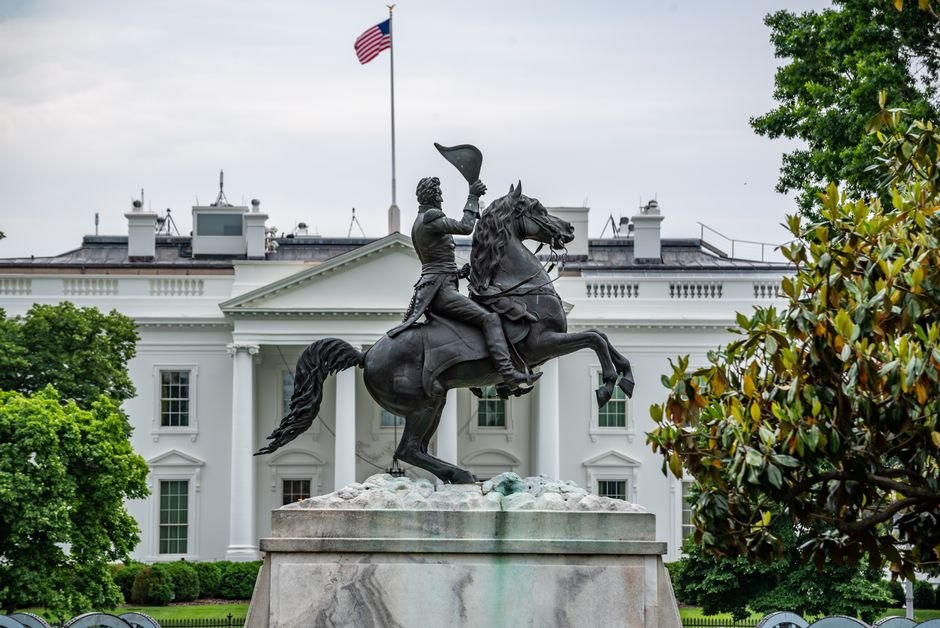
Trump pointed to a new Columbus statue installed on White House grounds earlier this year as evidence of his administration's stance. After protesters toppled a Columbus sculpture in Baltimore in 2020, officials erected a 13-foot replica made from fragments of the original piece in March in front of the Eisenhower Executive Office Building.
"In this administration, we know that Christopher Columbus is – to us he's a hero," Trump said at the Oct. 9 event. He also called for the return of a Columbus statue removed from outside city hall in Columbus, Ohio, in 2020.
Trump has consistently defended Columbus throughout his political career. In a 2020 Columbus Day proclamation, he wrote that "radical activists have sought to undermine Christopher Columbus's legacy" and sought to "replace discussion of his vast contributions with talk of failings." In April 2025, months into his second term, he posted on Truth Social that he was "bringing Columbus Day back from the ashes." An October 2025 proclamation described Columbus as "a prime target of a vicious and merciless campaign to erase our history, slander our heroes, and attack our heritage."
The Indigenous Peoples' Day Alternative
While Columbus Day remains a federal holiday, a growing number of states and cities have shifted to observing the second Monday in October as Indigenous Peoples' Day. The change recognizes that Native Americans populated the Americas long before Columbus's arrival and acknowledges the devastating loss of life, tradition, and lands that followed European contact, according to the Smithsonian National Museum of the American Indian.
Former President Joe Biden became the first president to issue a proclamation recognizing Indigenous Peoples' Day in 2021. "For generations, Federal policies systematically sought to assimilate and displace Native people and eradicate Native cultures," Biden wrote. "Today, we recognize Indigenous peoples' resilience and strength as well as the immeasurable positive impact that they have made on every aspect of American society."
Why the Debate Matters
The competing observances reflect a deeper national disagreement over how American history should be remembered in public spaces. For Italian American communities, Columbus has long served as a symbol of heritage and contribution to the United States. For many Native Americans and their allies, the explorer represents the beginning of centuries of displacement and violence.
Trump's rhetoric frames the statue removals as political vandalism by ideological opponents. Advocates for Indigenous Peoples' Day describe the shift as a necessary correction to historical narratives that have marginalized native perspectives. The federal government continues to recognize Columbus Day, but the presidential proclamation now shares the calendar with a separate Indigenous Peoples' Day acknowledgment — a duality that mirrors the unresolved tension in how the country confronts its past.