

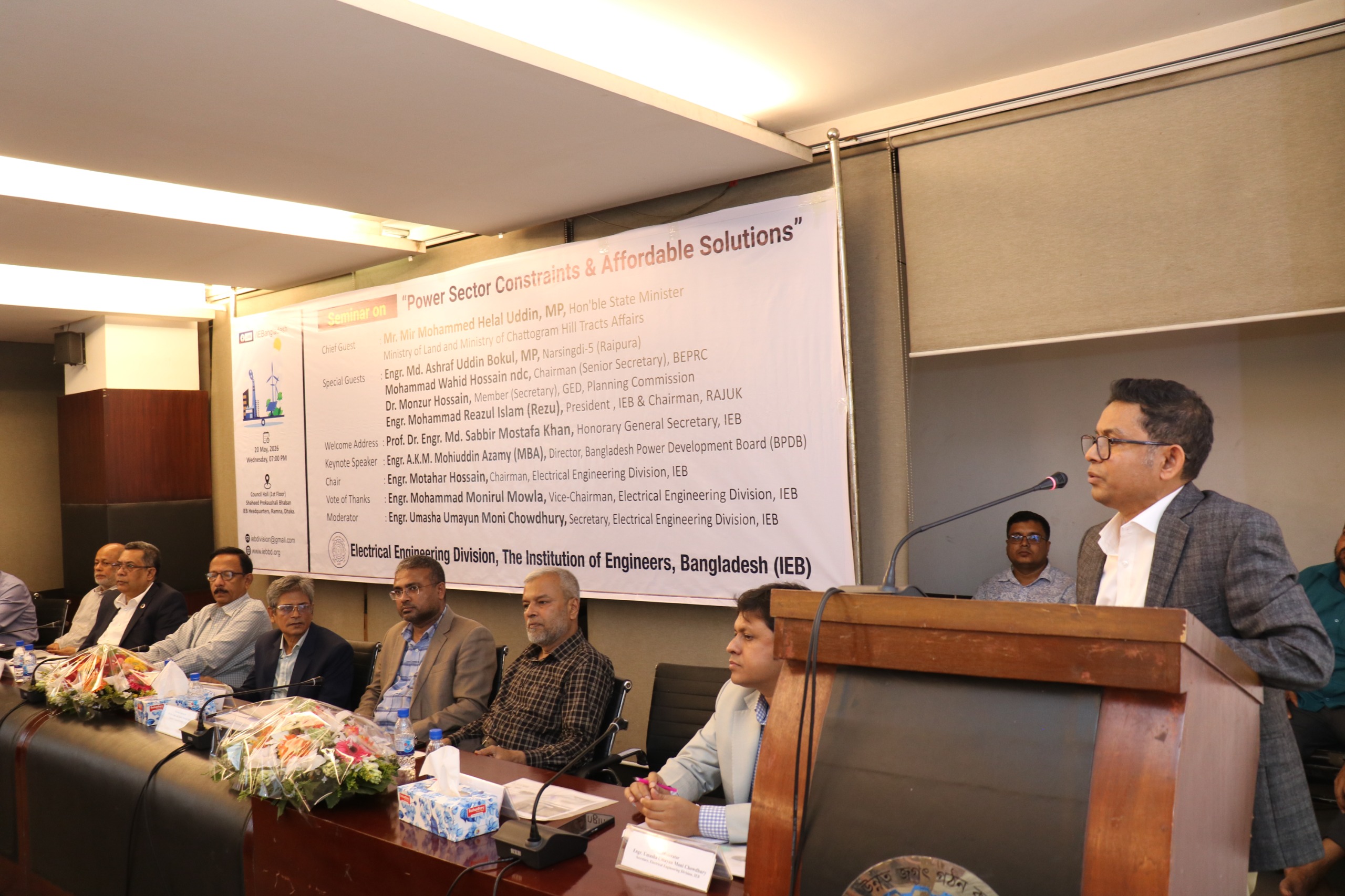
Bangladesh’s power sector is struggling to operate at full capacity despite significant expansion in electricity generation infrastructure, as fuel shortages, rising production costs, and import dependency continue to create major operational constraints, experts said at a seminar in Dhaka.
The observations were made at a seminar titled “Power Sector Constraints & Affordable Solutions”, held on Wednesday at the headquarters of the Institution of Engineers, Bangladesh (IEB) in Ramna. The event was organized by the IEB Electrical Engineering Division.
Speakers noted that although power generation capacity has increased in recent years, many plants remain underutilized due to insufficient fuel supply, high costs of imported energy, and growing subsidy pressures on the government.
The chief guest, State Minister for Land and Chittagong Hill Tracts Affairs Mir Mohammad Helal Uddin, said Bangladesh must accelerate its transition toward renewable energy to ensure long-term energy security.
He emphasized expanding rooftop solar systems, utilizing agricultural land, government khas land, and unused land for solar power generation, and highlighted a government plan to produce 5,000 megawatts of electricity from renewable sources with private sector participation.
Bangladesh Energy Regulatory Commission (BERC) Chairman Bangladesh Energy Regulatory Commission Mohammad Wahid Hossain said fuel scarcity remains the country’s biggest energy challenge, while renewable energy adoption is still significantly behind target.
He stressed the need for long-term planning, better energy import negotiations, and restructuring or phasing out inefficient energy institutions to reduce financial burdens.
Planning Commission’s General Economics Division (GED) member General Economics Division Dr. Monzur Hossain said Bangladesh has sufficient generation capacity but cannot utilize it fully due to fuel shortages, leaving many power plants operating below capacity.
He called for increased investment in solar, wind, and other renewable sources to reduce import dependency and strengthen energy security.
IEB Honorary Secretary General Professor Dr. Engineer Md Sabbir Mostafa Khan said past reliance on quick rental power plants has created long-term financial pressure due to heavy subsidies, adding that land scarcity remains a key challenge for large-scale solar expansion.
Presenting the keynote paper, Bangladesh Power Development Board (BPDB) Director Engineer AKM Mohiuddin Azmi said the sector faces mounting pressure from imported LNG, coal, oil dependency, high production costs, and infrastructure limitations.
He recommended expanding rooftop solar, solar parks, and utilizing khas land for renewable energy projects to reduce costs and improve long-term sustainability.