

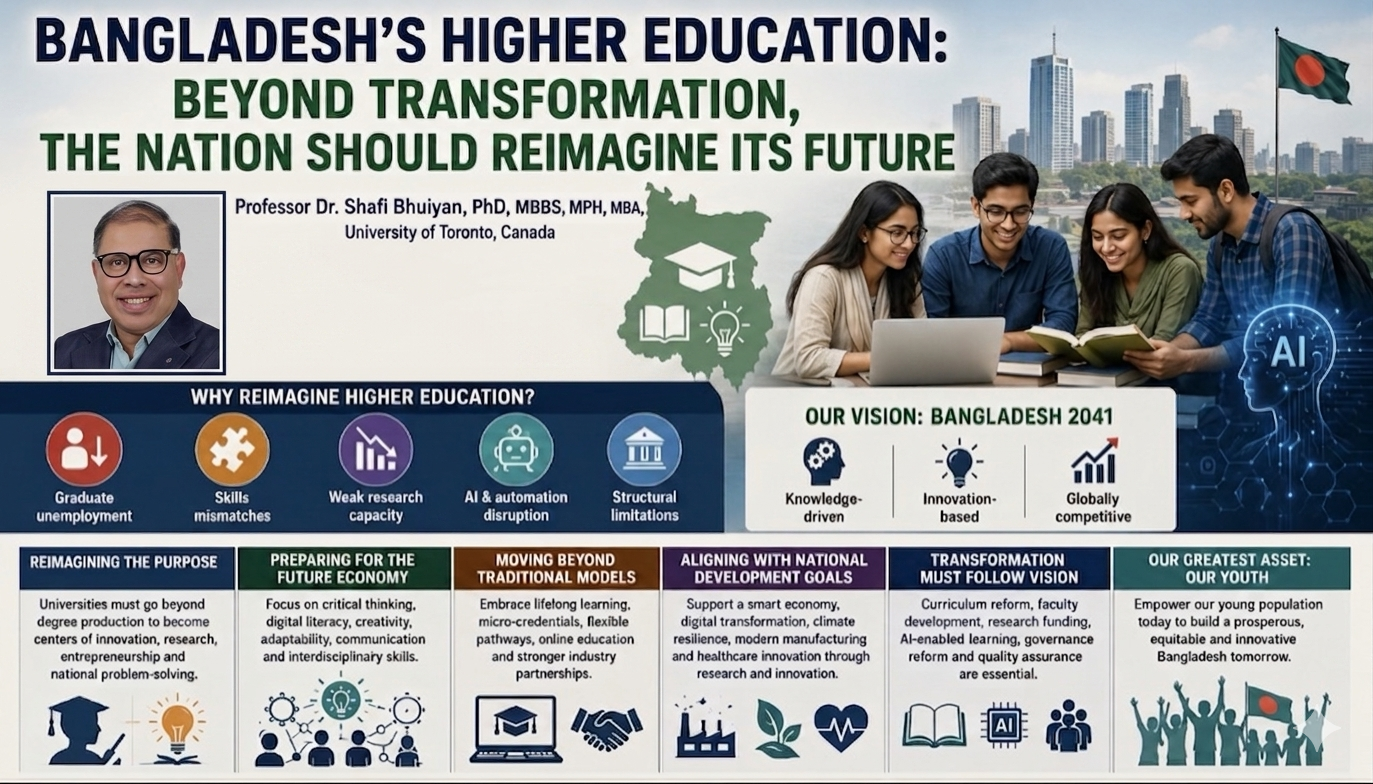
To build the Bangladesh of tomorrow, higher education must be reimagined today. Bangladesh stands at a defining moment in its national development journey. While the country continues to experience economic growth, rapid digital expansion, and deeper global integration, serious concerns are emerging within the higher education sector. Graduate unemployment, skills mismatches, weak research capacity, and the disruptive rise of artificial intelligence and automation are exposing structural limitations that can no longer be ignored.
Against this backdrop, a fundamental national question has become increasingly urgent:
Should Bangladesh merely transform its higher education system, or must it first reimagine what higher education should mean for the nation's future?
The answer may determine whether Bangladesh can successfully transition into a knowledge-driven, innovation-based economy by 2041.
Transformation alone is no longer enough. Over the past several decades, Bangladesh’s higher education system has expanded rapidly in terms of the number of institutions, enrollment, and access. Yet despite this quantitative growth, many structural weaknesses remain deeply embedded.
Much of the system still relies heavily on memorization-based learning, examination-centered evaluation, weak university–industry collaboration, limited research culture, and significant disparities between urban and rural institutions.
Although digital technologies are gradually entering classrooms, technology alone cannot solve deeper educational challenges if the underlying philosophy of education remains unchanged.
Without redefining the purpose and direction of higher education, Bangladesh risks creating a modernized version of an outdated system rather than building institutions capable of preparing future generations for a rapidly changing world.
Reimagining the Purpose of Higher Education
The first step must be a national reconsideration of what higher education is truly meant to achieve. Should universities primarily produce degree holders and job seekers, or should they become centers of innovation, entrepreneurship, research, and national problem-solving?
As Bangladesh aspires to become a developed nation, universities can no longer function solely as certificate-producing institutions. They must evolve into engines of knowledge creation, technological advancement, and social transformation.
Preparing Graduates for the Future Economy
The global labour market is changing at an unprecedented pace. Artificial intelligence, automation, and digital technologies are reshaping industries and redefining the nature of work. Future graduates will require far more than academic knowledge alone.
Skills such as critical thinking, digital literacy, communication, adaptability, interdisciplinary learning, and entrepreneurial capacity will become increasingly essential.
Yet many current academic programs continue to prioritize content recall over creativity and problem-solving. Unless universities adapt quickly, Bangladesh may face a widening gap between educational outcomes and labor market realities.
Moving Beyond Traditional Degree Models
Around the world, higher education is undergoing a profound transformation. Universities are increasingly embracing lifelong learning, micro-credentials, flexible learning pathways, online education, and stronger industry partnerships.
Bangladesh now has a unique opportunity to leapfrog outdated educational models and build a more flexible, innovation-oriented system suited to the realities of the 21st century.
Universities Must Align with National Development Goals
Bangladesh’s ambitions extend far beyond economic growth. The country seeks to build a smart economy, accelerate digital transformation, strengthen climate resilience, modernize manufacturing, and improve healthcare innovation.
To support these national priorities, universities must become active contributors to development through research, innovation, startup ecosystems, policy solutions, and local problem-solving initiatives.
Higher education can no longer remain disconnected from the country’s broader economic and social aspirations.
Transformation Must Follow Vision
Once a clear national vision is established, meaningful transformation can begin.
This transformation may include curriculum modernization, faculty development, expanded research funding, AI-enabled learning systems, governance reform, international partnerships, and stronger quality assurance mechanisms.
However, such reforms will only succeed if they are guided by a broader educational philosophy and long-term national strategy.
Reimagining Higher Education Is Critical
Bangladesh’s greatest national asset is its young population. If properly educated and empowered, this demographic advantage could fuel decades of innovation and economic growth.
But if the higher education system remains misaligned with future realities, the country risks producing increasing numbers of educated yet unemployable graduates — potentially contributing to social frustration, inequality, and economic stagnation.
The global economy increasingly rewards nations that invest in creativity, innovation, adaptability, and knowledge production. Countries leading higher education today are not merely improving universities; they are redefining the role universities play in society.
Way Forward: A Two-Phase National Roadmap
To move the higher education system forward, Bangladesh should adopt a two-phase national strategy.
Phase I: Reimagining the Higher Education System
Let's start a nationwide dialogue with universities, policymakers, industry leaders, students, researchers, and international partners to define the future purpose and direction of higher education in line with the country’s Vision 2041 goals.
Phase II: Transforming the Higher Education System
Once a shared national vision is established, strategic reforms can be implemented through curriculum redesign, expansion of digital infrastructure, research ecosystems, faculty training, employability-focused learning, and governance modernization.
In conclusion, after 55 years of independence, Bangladesh’s higher education system still lags behind global standards in many critical areas. The country has now reached a stage where incremental educational reform is no longer sufficient.
Transformation without reimagining may only produce a more efficient version of an outdated system.
To build a truly innovative, globally competitive, and knowledge-driven Bangladesh, the country must first rethink the purpose of higher education itself — and then transform institutions accordingly. The future of Bangladesh may well depend on the decisions made today about how its universities educate tomorrow's generations.