

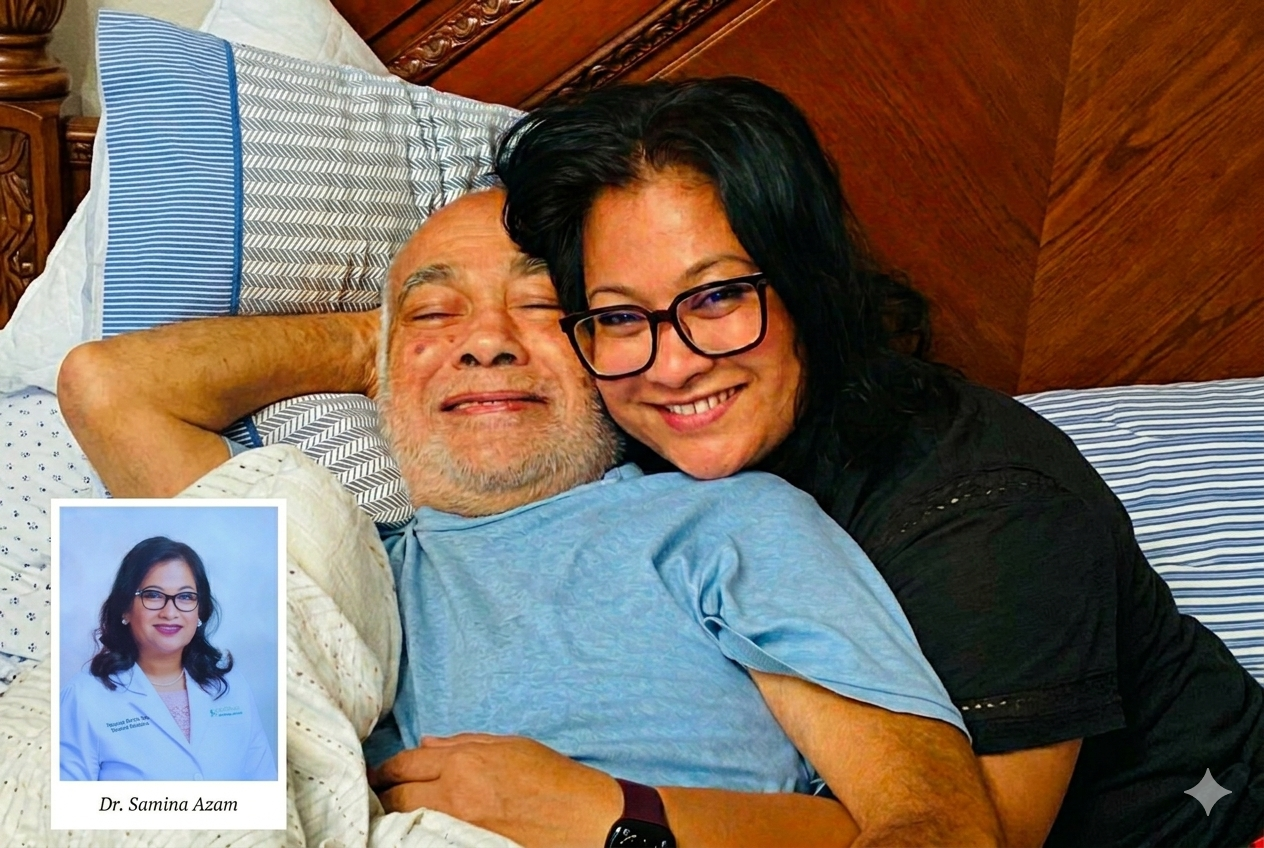
By- Dr. Samina Azam
Florida। May 14, 2026: What I am writing is not meant to blame or attack any individual physician, nurse, or hospital. As a doctor myself, I understand how difficult and emotionally exhausting critical care medicine can be. I know many healthcare professionals work tirelessly under immense pressure every single day to save lives.
But I am sharing my father’s story because silence will not protect future patients. I am sharing this because I believe we urgently need more awareness, accountability, stronger infection control, and a healthcare culture where patient safety is treated as sacred. If even one family becomes more aware, one healthcare worker becomes more vigilant, or one hospital strengthens its infection prevention practices after reading this, then my father’s suffering will not have been entirely in vain.
My Abba survived so much in life — but in the end, he could not survive the very hospital system meant to heal him. And it leaves me wondering: how many more loved ones must we lose before hospital-acquired infections and delayed critical care are taken seriously?
Even at 83 years old, despite multiple co-morbidities, Abba was remarkably disciplined about his health. He remained physically active, mentally engaged, and deeply proud whenever his doctors told him his reports looked good. He would often call me happily just to say he had once again “passed” all his tests in flying colors.
As he aged, he developed mild dementia, but it was relatively stable with medications, routine, and mental exercises. Then came August 5, 2024— a devastating turning point in our lives. At 82 years old, he was arrested on false cases and kept in jail for nearly 10 months. During that period, he did not receive proper medical care or regular medications, and his dementia worsened significantly. The prolonged isolation caused irreversible cognitive decline. Anyone who has cared for dementia patients understands how essential family, familiarity, conversation, and emotional connection are. Slowly, solitary confinement took those pieces of him away from us.
At one point, he nearly died from sepsis and required ICU care at PG Hospital and later at Square Hospital. By Allah’s mercy, he survived. After finally receiving bail and returning home, he was profoundly weak — needing assistance from two people just to walk to the bathroom. Yet through determination, physical therapy, and sheer willpower, he slowly regained some independence. Within months, he was walking with a walker on his own. His short-term memory remained impaired, but he still recognized loved ones, shared stories from the past, and participated in conversations.
Then another tragedy struck our family.
This March, my chacha suffered a fall and was hospitalized. After being discharged, he rapidly developed severe respiratory distress and had to be readmitted. He was diagnosed with hospital-acquired pneumonia caused by Acinetobacter — a highly dangerous and often multidrug-resistant bacteria. He was intubated, admitted to the ICU, and eventually passed away. Abba visited him and attended his janazah in the village.
Roughly ten days after returning home, Abba developed fever and shortness of breath. He was admitted to the hospital and diagnosed with pneumonia caused by Haemophilus influenzae. Because of his interstitial lung disease, he required high-flow oxygen and was admitted to the HDU. During that admission, a Foley catheter was inserted and remained in place for nearly ten days.
As his breathing improved and his oxygen needs decreased, he was transferred to a cabin. This was when I arrived to see him. One of my biggest concerns was the prolonged Foley catheter use because of the infection risk. I repeatedly asked if it could be removed, and eventually it was. Thankfully, he improved enough to be discharged home.
For three beautiful days, he seemed to be recovering again. He restarted physical therapy and was able to walk from his bedroom to the drawing room to sit and eat meals with us. Those simple moments now feel priceless.
Then suddenly, on the third day, he developed high fever with severe chills and rigors. His condition deteriorated rapidly, and he developed urinary retention. We rushed him back to the emergency department where the Foley catheter was reinserted and urine tests were sent. He was discharged home again, but throughout the day I could see he was becoming septic. We brought him back immediately.
What followed was one of the most painful experiences of my life.
Even after admission, it took several hours for blood work and cultures to be collected. I repeatedly expressed concern that he was septic and urgently needed antibiotics, but the response was that they were waiting for the consultant. When the consultant finally arrived, the seriousness of his condition was recognized immediately and treatment was started.
Then came the heartbreaking discovery: one of his sputum cultures from the previous admission had already returned positive for hospital-acquired Acinetobacter — the same dangerous bacteria my chacha had — along with coagulase-negative staph. Yet nobody had informed us after discharge. He had unknowingly been taking antibiotics at home that were ineffective against the infection.
Soon afterward, both his urine and blood cultures grew CRE Klebsiella, another highly resistant hospital-acquired organism that I strongly believe was linked to the prolonged Foley catheter use.
The burden of infection overwhelmed his body.
He developed atrial fibrillation with persistent rapid heart rates, which eventually led to heart failure. Again, there were delays in escalation of care while waiting and monitoring continued. By the time specialists became involved, his breathing had significantly worsened due to pulmonary edema.
I watched my father struggle for every breath while fluid accumulated in his lungs. I repeatedly pleaded for faster diuresis and more urgent intervention, but delays continued until he developed flash pulmonary edema and required ICU transfer and high-flow oxygen support. Eventually he needed BiPAP before more aggressive treatment was initiated. Slowly, he stabilized again and was weaned back down to nasal cannula oxygen. For a brief moment, we felt hopeful.
But the cycle continued.
Just before I was due to return to the USA, I noticed he was becoming lethargic again and requiring more oxygen. His blood gases showed carbon dioxide retention. I requested that BiPAP be restarted, but again the plan was to continue monitoring.
I left feeling deeply unsettled and afraid.
Soon after landing in the United States, I received devastating updates from my family. His breathing worsened dramatically. His blood pressure dropped. He required vasopressors. Sadly he was reinfected for second time in ICU as his CRP again rose to 238 from 74. The repeat blood culture showed there was profuse growth of some bacteria not yet finalized. His kidneys began failing. Despite concerns about worsening renal injury, aggressive diuresis continued until his kidneys ultimately shut down completely. Only then was nephrology consulted and dialysis initiated.
By that stage, my father was nearly comatose. He briefly opened his eyes at times, but his body had endured too much. He tolerated dialysis overnight, but by morning he no longer had the strength to continue fighting.
And then we lost him forever.
During those 15 days in the ICU, one reality disturbed me profoundly. Initially, he was placed in isolation because of his multidrug-resistant infections, and even family members were restricted from entering. Yet I repeatedly witnessed healthcare staff moving between rooms without proper gowns, gloves, or masks. That was the moment I realized why these infections continue spreading so aggressively in many healthcare settings.
Our family wore full PPE every time we entered his room once permitted, yet many staff members did not consistently do the same. How can hospital-acquired infections be controlled if infection prevention protocols are not followed rigorously and consistently? At one point, we were even told that parts of the oxygen system itself may have been contaminated. It felt like an endless and devastating cycle.
As a physician trained in the United States, I was heartbroken by the gaps I witnessed — delayed recognition of emergencies, delayed treatment, inadequate infection control practices, poor communication regarding critical culture results, and a system that often reacted only after patients had already deteriorated significantly.
And that leaves me asking an even more painful question:
If I, as a physician, struggled to advocate effectively for my own father despite understanding the medical system, what happens to ordinary families who do not recognize the warning signs of sepsis, respiratory failure, or multidrug-resistant infections?
Families bring their loved ones to hospitals with trust and hope. They believe the ICU is the safest place for critically ill patients. But too often, what I witnessed felt like a system where vulnerable patients can become trapped in a cycle of invasive devices, hospital-acquired infections, delayed intervention, and preventable deterioration.
My father fought his entire life — for his country, for his family, for his health, and even through dementia and severe illness he continued fighting until the very end. But eventually, his body could no longer survive the relentless burden of resistant infections and repeated complications.
So today, I am not writing this only as a grieving daughter. I am writing this as a physician, as a human being, and as someone desperately hoping for change.
How do we stop this cycle?
How do we better protect vulnerable ICU patients from hospital-acquired infections?
How do we ensure timely recognition of sepsis and critical deterioration?
How do we strengthen infection prevention practices so multidrug-resistant bacteria stop spreading between patients?
How do we build healthcare systems where families feel informed, heard, and safe?
And most importantly — how many more families must watch their loved ones slowly slip away before meaningful reforms in patient safety and infection control finally become a national priority?
Finally, I want to recognize that the consultants consistently identified the seriousness of my father’s condition and made sincere efforts to provide the best possible care. Despite their dedication, experience, and compassion, the overwhelming patient load and systemic constraints meant that, in the end, they were unable to save my father.
Join our facebook page: (Click Below) https://www.facebook.com/share/1Cc6EyQXue/?mibextid=wwXIfr