
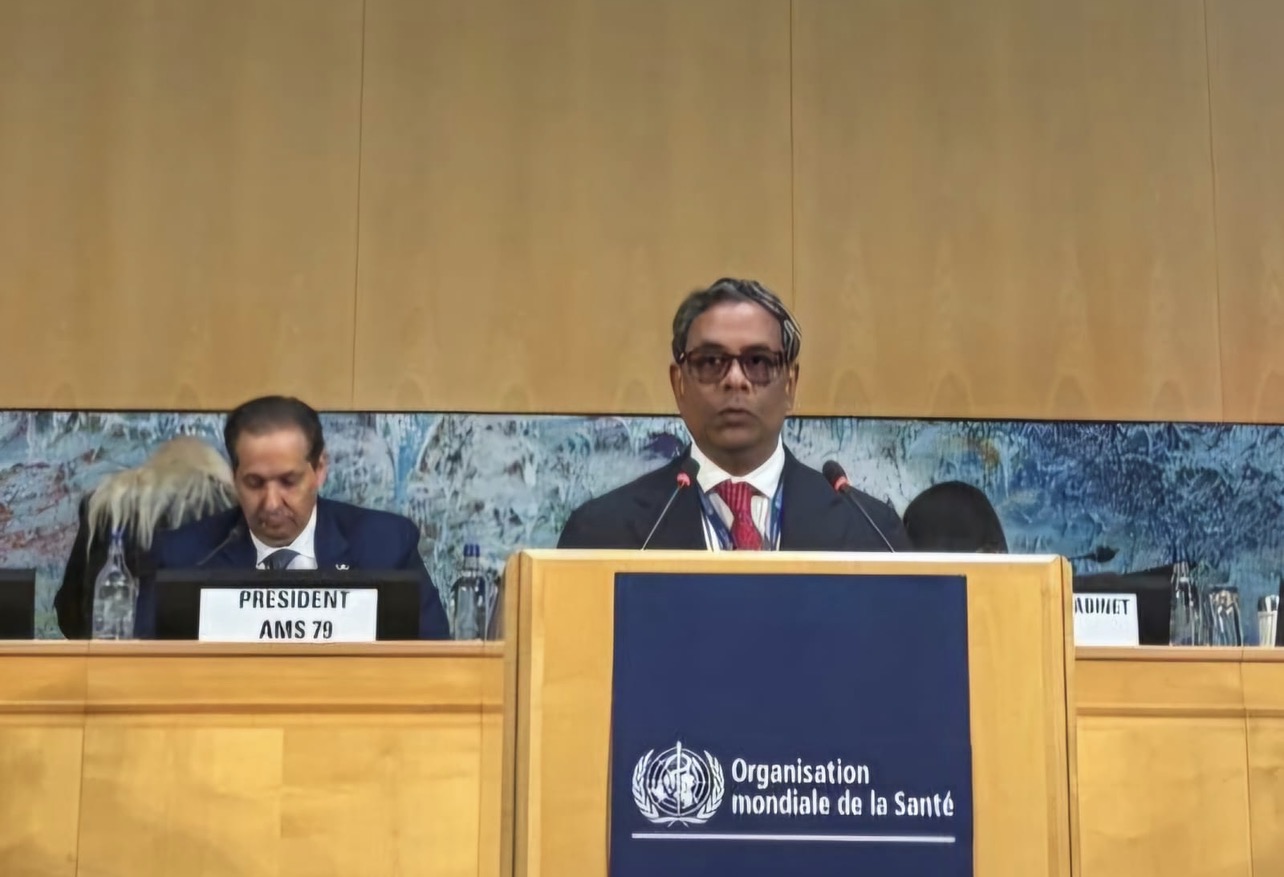
Geneva, Switzerland: Bangladesh has reaffirmed its commitment to strengthening the country’s healthcare system and expanding universal health coverage at the 79th World Health Assembly currently underway in Geneva, Switzerland. The Bangladesh delegation is being led by Health and Family Welfare State Minister Dr. M A Muhit.
Addressing the main session of the global summit on May 19, Dr. Muhit said the new government has placed healthcare at the center of national development priorities. However, he noted that more than 70 percent of the country’s total health expenditure still comes directly from people’s pockets, pushing many families toward poverty.
To address the challenge, he said the government is gradually increasing public health spending while expanding integrated primary healthcare services, strengthening referral systems, and modernizing healthcare through digitalization.
The six-member high-level Bangladeshi delegation is participating in the world’s largest global health gathering, where leaders and policymakers are discussing major international health challenges and reforms.
On the sidelines of the assembly, Dr. Muhit also joined a policy-level meeting of the Global Alliance for Vaccines and Immunization (Gavi), alongside health ministers from various countries.
Highlighting Bangladesh’s ongoing healthcare reforms, the state minister said the government is working to expand healthcare access for all citizens, integrate public and private health data systems, strengthen infectious disease prevention, and improve services related to mental health, disability-friendly healthcare, and non-communicable diseases. Various awareness programs promoting healthy lifestyles are also being implemented, he added.
Dr. Muhit expressed concern over the growing health impacts of climate change on Bangladesh, describing the country as being on the frontline of climate vulnerability. He warned that changing disease patterns caused by climate change are placing enormous pressure on the country’s healthcare infrastructure.
He also pointed to the long-term burden created by the presence of more than 1.3 million forcibly displaced Rohingya refugees from Myanmar, saying the crisis continues to strain Bangladesh’s limited healthcare resources and infrastructure.
Calling for greater international solidarity, Dr. Muhit urged world leaders to finalize a safe, transparent, accountable, and equitable “Pathogen Access and Benefit Sharing” system as quickly as possible.
He further emphasized the need for stronger global cooperation to address non-communicable diseases and antimicrobial resistance, warning that these silent threats are becoming increasingly dangerous amid shrinking global health financing, conflicts, and humanitarian crises.