

From major cities to rural communities—why a family physician-based healthcare system could become the cornerstone of stronger public health, lower healthcare costs, and Universal Health Coverage (UHC) in Bangladesh.
Whenever healthcare development in Bangladesh is discussed, conversations often focus on new hospitals, specialized medical services, advanced technologies, or ICU expansion. However, one fundamental question is frequently overlooked: Where should people go first when they become ill? Who will understand their long-term health history, coordinate their care, and provide continuous health guidance? More importantly, how can families access quality healthcare without falling into financial hardship from rising out-of-pocket costs?
The reality is that the foundation of an effective, humane, and cost-efficient healthcare system is not hospitals alone; rather, it is strong primary healthcare and a strong family physician (FP) or general practitioner (GP) model. Countries with advanced healthcare systems realized long ago that without accessible and reliable primary care at the community level, hospital- and specialist-driven healthcare systems cannot remain sustainable.
Today, global public health experts and policymakers widely recognize that strong family physician systems are essential to improving population health, reducing health inequities, strengthening preventive care, managing chronic diseases, and lowering healthcare costs. This has become increasingly important in an era marked by rapid urbanization, aging populations, diabetes, hypertension, cancer, mental health conditions, maternal and child health, safe pregnancy, reproductive and family planning services, continuity of care across the life course, and the growing burden of non-communicable diseases.
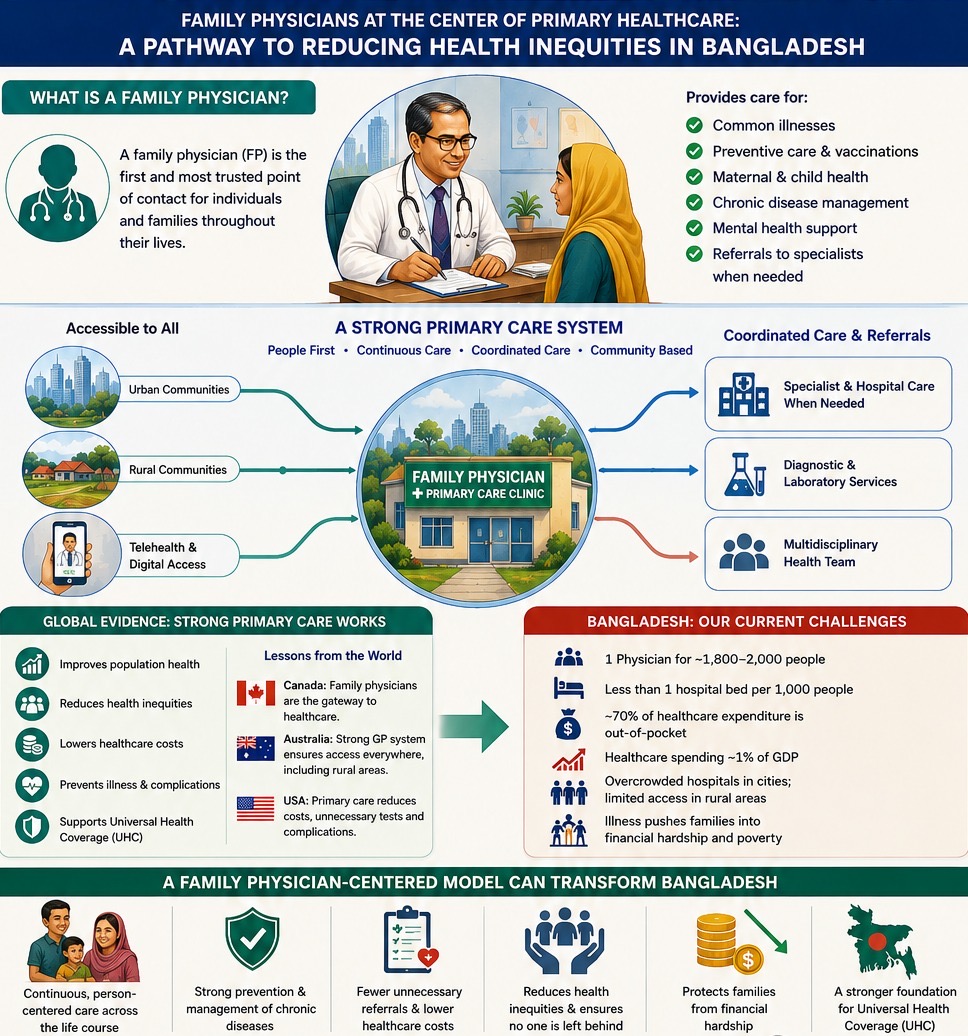
In straightforward terms, a family physician is a doctor who serves as the first and most trusted point of contact for individuals and families throughout their lives. From children to older adults, family physicians provide care for common illnesses, preventive healthcare, vaccinations, maternal and child health, chronic disease management, mental health support, and referrals to specialists when necessary. Instead of patients consulting specialists directly for every health concern, a family physician assesses the situation, provides appropriate treatment, and coordinates referrals when specialized care is required.
As we move forward, the experiences of developed countries provide valuable lessons. In Canada, family physicians are considered the ‘gateway’ to healthcare. Most citizens have a dedicated family doctor who understands their long-term medical history and refers them to specialists when needed. In Australia, the General Practitioner (GP) system is highly developed, particularly in rural and underserved regions, where community-based healthcare models ensure access to essential services. Through telehealth, community clinics, and team-based care, citizens receive frontline healthcare efficiently.
In the United States, despite a different insurance-based healthcare structure, the concept of the Primary Care Physician (PCP) remains highly important. Many insurance systems limit access to specialists without an initial assessment by a primary care provider. Research consistently shows that strong primary healthcare reduces unnecessary tests, lowers healthcare expenditures, and significantly decreases disease complications.
Bangladesh, however, faces a different and more complex reality. Although public investment in healthcare has increased, national health expenditure remains limited relative to the country’s GDP and growing healthcare needs. In the 2024–25 fiscal year, healthcare spending exceeded approximately BDT 41,000 crore, yet this remains close to only 1% of GDP. Government healthcare spending per capita is still comparatively low for a rapidly growing population.
Healthcare infrastructure constraints are also concerning. Various estimates suggest that in Bangladesh, one physician is responsible for approximately 1,800 to 2,000 people, while hospital bed capacity remains insufficient, with fewer than 1 bed per 1,000 people. As a result, major urban hospitals experience overwhelming pressure, while many rural populations struggle to access quality healthcare services.
Even more concerning is the financial burden on ordinary citizens. Nearly 70% of total healthcare expenditure in Bangladesh continues to come directly from people’s own pockets (out-of-pocket spending). As a result, illness often forces families to rely on personal savings, loans, or even the sale of assets to pay for treatment. For many households, healthcare costs can quickly lead to financial hardship and poverty. Healthcare, therefore, becomes not only a medical issue but also a matter of social and economic justice.
This is where a family physician-centered healthcare model could become transformative for Bangladesh. Common illnesses such as fever, respiratory infections, diabetes, hypertension, maternal health concerns, child nutrition issues, and stress-related mental health conditions often do not require direct specialist consultation. A well-trained family physician can effectively manage most of these conditions at the local level, reducing unnecessary referrals, lowering healthcare costs, and ensuring continuous, coordinated, and person-centered care.
The Government of Bangladesh has committed to achieving Universal Health Coverage (UHC), ensuring that no citizen suffers financial hardship in accessing essential healthcare services. However, achieving UHC is not simply about building more hospitals. International evidence shows that effective UHC depends on strong primary healthcare systems supported by a gatekeeping model, in which the first point of contact is a family physician or a community-based primary care provider.
For Bangladesh, to ensure no one is left behind, several practical steps are urgently needed. First, family medicine should be established as a respected and attractive medical specialty. Second, community-based family physician centers should be developed at the union, sub-district, and urban levels. Third, a structured referral system should be introduced to reduce unnecessary reliance on specialists for common medical conditions. At the same time, Bangladesh should gradually strengthen national health insurance systems, digital health records, telemedicine, and team-based primary care involving qualified graduate nurses, pharmacists, nutritionists, and social workers.
Above all, Bangladesh must shift from a hospital-centred healthcare mindset to a people-centered healthcare system. The experiences of developed countries clearly demonstrate that when every person has access to a trusted family physician, healthcare systems become more effective not only in treating illness but also in preventing disease, reducing inequities, controlling healthcare costs, and improving population health outcomes.
Bangladesh now faces an important policy choice: Do we just want more hospitals, or do we want an effective healthcare system where every family has access to a trusted family physician as the first point of care? Investing in strong primary healthcare and family medicine may not only reduce health inequities and healthcare costs, but also help build a healthier, more resilient, and people-centered Bangladesh for future generations.