

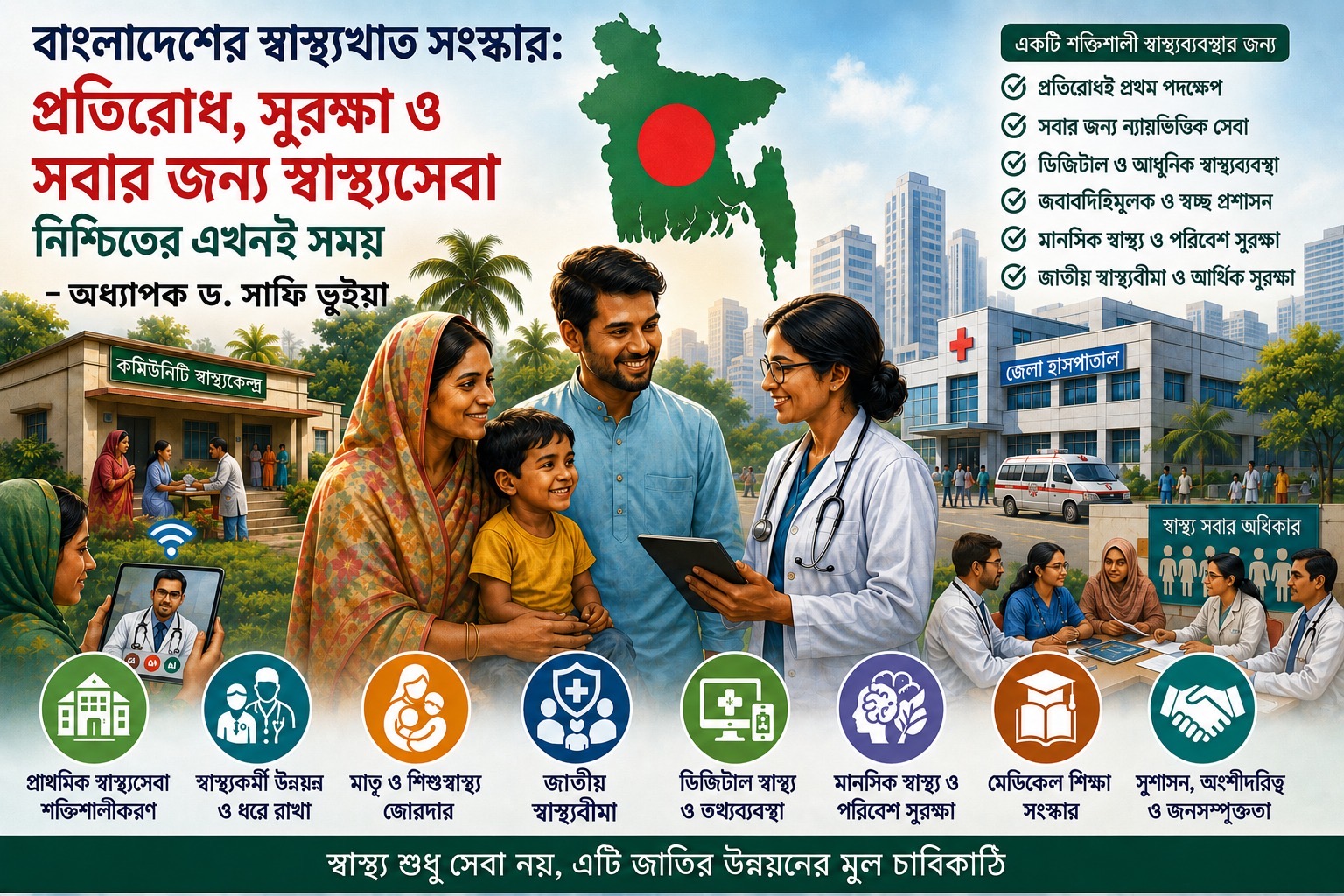
Bangladesh’s healthcare sector stands at a critical crossroads today. Over the past few decades, the country has achieved remarkable progress in maternal and child health, vaccination coverage, life expectancy, and the control of infectious diseases. However, establishing a healthcare system that is responsive, proactive and preventive, accountable, transparent, and truly patient-centered remains a major challenge.
Our healthcare system still largely depends on a “treat after illness occurs” (Reactive Model). Yet, the demand of the time is a transformation toward a “disease prevention and early protection” (Proactive Model), where prevention, early detection, quality care, and overall citizen well-being are ensured before illness develops.
But the question remains: why has Bangladesh still not been able to build an effective, humane, and patient-centered healthcare system?
The answer lies in several important political, administrative, and structural barriers. Without addressing these challenges, sustainable reform in the healthcare sector will not be possible.
1. Excessive Political Interference in the Healthcare Sector
Political influence often plays a significant role in appointments, promotions, transfers, hospital administration, and project approvals within Bangladesh’s healthcare system. As a result, loyalty is sometimes prioritized over merit and competence, undermining institutional accountability and professionalism.
To establish a modern healthcare system, it is essential to create an independent National Health Service Commission that ensures transparency in recruitment and evaluation. At the same time, professional healthcare managers should be appointed to oversee hospital administration, and a multi-party parliamentary health committee should be formed to prevent policy changes with every change in government.
2. Corruption and Lack of Transparency
Irregularities and corruption in medicine procurement, medical equipment purchases, infrastructure development, and workforce recruitment continue to erode public trust and negatively impact service quality.
To address these challenges, it is crucial to implement digital e-procurement systems, hospital-based financial transparency dashboards, independent audit systems, and whistleblower protection policies.
3. Lack of Continuity in Health Policies
In Bangladesh, many good healthcare initiatives are halted or restarted whenever governments change. As a result, long-term healthcare reforms are often disrupted.
The healthcare sector must be elevated above partisan politics through the introduction of a National Health Reform Act and a 10–15 year national healthcare roadmap. Healthcare policy should be a matter of state policy, not party politics.
4. Excessive Centralization
Because decision-making remains highly Dhaka-centric, resolving healthcare challenges at the district and উপজেলা (sub-district) levels is often delayed. Centralized decisions frequently fail to align with local realities, reducing effectiveness.
To overcome this, Bangladesh needs decentralized healthcare administration, empowerment of local health managers, and the establishment of community health boards to ensure local participation.
5. Lack of a Patient-Centered Healthcare Culture
Many patients in Bangladesh still do not receive respectful treatment, adequate information, timely care, or humane medical services. The healthcare system remains largely institution-centered rather than patient-centered.
To change this culture, Bangladesh should implement a Patient Rights Charter, provide communication and empathy training for healthcare workers, establish digital complaint and feedback systems, and introduce Patient Satisfaction Key Performance Indicators (KPIs).
6. Limitations in Healthcare Budget and Political Priorities
Government investment in healthcare remains insufficient. Preventive healthcare, mental health services, primary healthcare, and healthcare technology often do not receive the priority they deserve.
Healthcare should be viewed not as an expense, but as a long-term national investment. Bangladesh should allocate a fixed percentage of GDP to healthcare, adopt a “Primary Healthcare and Prevention-First Model,” gradually implement Universal Health Insurance, and expand public-private partnerships.
7. Limited Political Commitment and Citizen Participation
Patients, physicians, nurses, public health experts, researchers, and civil society organizations still have limited involvement in health policy formulation.
A national healthcare dialogue platform should be established to include all stakeholders, ensuring that health policies are practical and people-oriented.
A Realistic Five-Phase Healthcare Reform Roadmap for Bangladesh
Phase One (1–2 Years)
Focus on governance reform, anti-corruption measures, digital procurement systems, and hospital audits.
Phase Two (2–3 Years)
Strengthen primary healthcare services, expand telemedicine, and increase the number of community healthcare workers.
Phase Three (3–4 Years)
Develop a patient-centered digital healthcare system, including electronic health records and improved health information management.
Phase Four (4–5 Years)
Gradually introduce national health insurance, beginning with low-income populations.
Phase Five (5–10 Years)
Promote a preventive healthcare culture, modernize medical education, and develop skilled healthcare leadership.
Conclusion
Establishing an accountable, transparent, proactive, and patient-centered healthcare system in Bangladesh is not solely the responsibility of the Ministry of Health. It should become a national political and social commitment.
The nation must now decide: do we simply want to treat sick people, or do we want to build a Bangladesh where people remain healthy, diseases are prevented, and healthcare is humane, equitable, and equally accessible to all?
Therefore, elevating the healthcare system above partisan politics and placing “Health for All” at the center of national development may become Bangladesh’s greatest humanitarian and economic investment for the future.