

By Md Shafiul Alam। May 11, 2026:
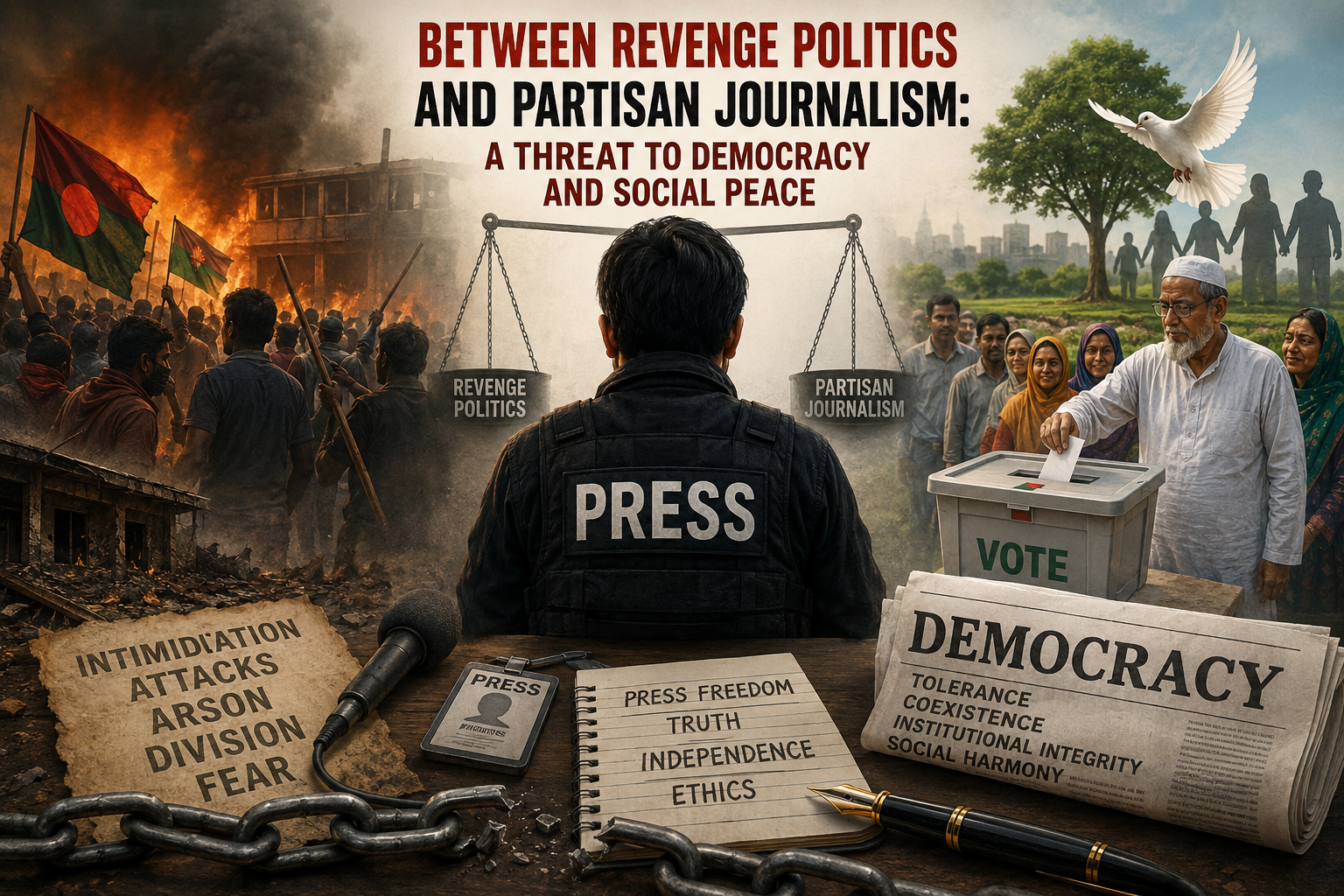
Democracy survives not merely through elections, but through tolerance, coexistence, institutional integrity, and freedom of expression. Unfortunately, both Bangladesh and the Indian state of West Bengal are witnessing an alarming rise in post-election violence, political vengeance, and the dangerous politicisation of journalism. These trends are steadily eroding democratic culture, weakening social harmony, and threatening the very foundation of civil society.
In recent years, election-related violence has increasingly become a recurring phenomenon in South Asia, particularly in Bangladesh and the Indian state of West Bengal. Elections are supposed to be festivals of democracy where differing political opinions coexist peacefully. Instead, they are turning into battlegrounds where the defeated fear retaliation and the victorious often seek revenge.
Political clashes, intimidation, arson, attacks on homes and businesses, and social ostracization after elections have become disturbingly common. In many cases, ordinary supporters-not just political leaders-become targets. Such retaliatory politics creates an atmosphere of fear across society.
The consequences are profound. Citizens gradually lose interest in political participation. Young people become discouraged from joining politics. Families begin to view political identity as a social risk rather than a democratic right. A culture of fear replaces political tolerance.
This cycle is particularly dangerous because revenge politics normalizes violence as a legitimate political tool. Once violence becomes embedded in political culture, democratic institutions begin to weaken silently.
Another deeply concerning issue is the vulnerability of minority communities during political unrest. In Bangladesh and parts of India, minorities often become soft targets after elections. While these attacks are frequently portrayed as purely communal or religious, the reality is often more complex and politically motivated.
In many cases, minority communities are targeted not only because of religious identity but also because they are perceived to support a particular political camp. Political opportunists exploit religious sentiments to consolidate power, seize property, intimidate opponents, or create instability.
This dangerous convergence of political rivalry and religious identity threatens social coexistence. It damages the secular and pluralistic values upon which democratic societies depend.
The policy of subjugating the weak by the strong transcends purely communal dimensions. Political actors frequently exploit the vulnerability of minorities for electoral and economic gains. However, acknowledging political manipulation must never diminish the real insecurity and suffering experienced by minority populations.
If minorities continue to feel unsafe during political transitions, it will create long-term distrust, migration pressures, and social fragmentation. No democratic nation can prosper while sections of its citizens live in fear because of identity or perceived political affiliation.
The crisis of partisan journalism in Bangladesh
Equally alarming is the growing proximity between sections of the media and political power in Bangladesh. Journalism, ideally, should function as the conscience of society-independent, objective, and accountable to truth. Instead, many journalists and media institutions are increasingly being drawn into partisan political alignments.
Over the years, some journalists have cultivated close ties with ruling political parties and power circles to secure professional benefits, influential positions, business opportunities, foreign trips, and institutional privileges. When their preferred political force remains in power, they flourish. But when political power changes hands, many of them become vulnerable.
Following the ouster of the Awami League government, more than one hundred journalists reportedly faced expulsion from the National Press Club, while many others encountered legal cases, detention, harassment, or professional marginalization. On the other hand, journalists perceived to be aligned with the Bangladesh Nationalist Party or sympathetic groups are now reportedly enjoying influential positions in media houses, editorships, and institutional platforms.
This creates a dangerous cycle. If political power changes again in the future, another wave of retaliation may follow. Such a tit-for-tat culture is devastating for press freedom, professional journalism, and democratic accountability.
A journalist should not become politically untouchable during one regime and persecuted during another. Journalism cannot survive as an extension of political patronage.
Decline of Professionalism
Fifteen or twenty years ago, despite political divisions, there existed comparatively greater professional distance between journalists and political parties in Bangladesh. Reporters from different ideological backgrounds worked together in newsrooms and professional bodies with a greater sense of collegiality and institutional respect.
Today, ideological polarisation has deeply penetrated media culture. Professional organisations are often divided along party lines. Merit, ethics, and journalistic standards sometimes become secondary to political loyalty.
This trend weakens public trust in the media. Citizens begin to question whether news is being reported objectively or politically engineered. Once public confidence in journalism collapses, misinformation and propaganda fill the vacuum.
The broader threat to democracy
The combination of revenge politics, communal exploitation, and partisan journalism presents a serious challenge to democracy in Bangladesh and the wider region.
When opposition supporters fear attacks after elections, democracy weakens. When minorities fear persecution during political changeovers, social harmony weakens.When journalists fear persecution depending on which party rules, press freedom weakens. And when all these happen simultaneously, democratic institutions gradually lose credibility.
The way forward
To reverse this dangerous trajectory, urgent reforms and collective social commitment are necessary.
1. Establish Political Accountability
Political parties must publicly commit to rejecting post-election violence and revenge politics. Party leadership should take responsibility for the conduct of their activists and supporters.
2. Protect minority communities
Governments and law enforcement agencies must ensure swift action against attacks on minorities regardless of political or religious considerations. Minority protection should be treated as a national democratic obligation.
3. Depoliticize journalist organizations
Professional journalist bodies should distance themselves from partisan politics. Leadership positions in press clubs and journalist unions should prioritiseprofessional competence and ethical credibility rather than political allegiance.
4. Strengthen media ethics
Media institutions must reinforce editorial independence and establish clear ethical guidelines preventing undue political influence over reporting and appointments.
5. Legal safeguards for journalists
Journalists should never face arbitrary detention, harassment, or professional discrimination because of perceived political identity. Legal protections for media professionals must be strengthened.
6. Promote democratic tolerance
Educational institutions, civil society, and political leaders must promote democratic values, including tolerance of opposing opinions, peaceful political participation, and coexistence.
Democracy cannot function in an environment dominated by fear, revenge, and partisan manipulation. Political competition should never become social warfare, and journalism should never become a battlefield of political patronage.
Bangladesh and neighbouring regions stand at a critical crossroads. The future stability of democracy depends not only on holding elections, but on nurturing a culture where citizens can differ politically without fear, minorities can live securely, and journalists can work professionally without changing loyalties according to shifts in power.
Rebuilding such a culture will not be easy. But unless political tolerance, professional ethics, and democratic coexistence are restored, both politics and journalism risk losing public trust, perhaps irreversibly.