

Bangladesh’s healthcare sector stands today at a critical crossroads. Over the past few decades, the country has achieved remarkable progress in maternal and child health, immunization programs, reduction of child mortality, and increased life expectancy. At the same time, however, major challenges remain — including inequality in healthcare access between rural and urban areas, rising treatment costs, shortages of healthcare workers, the growing burden of non-communicable diseases (NCDs), mental health concerns, and health risks associated with climate change.
During recent interim discussions where I was invited to contribute, I presented a detailed reform proposal. Whether those recommendations will ultimately guide policy remains uncertain, but I would like to share some of the key points here.
Drawing from more than two decades of international professional experience, I have come to believe that Bangladesh urgently needs a well-organized, forward-looking healthcare reform agenda aimed at making the system more effective, equitable, modern, and people-centered.
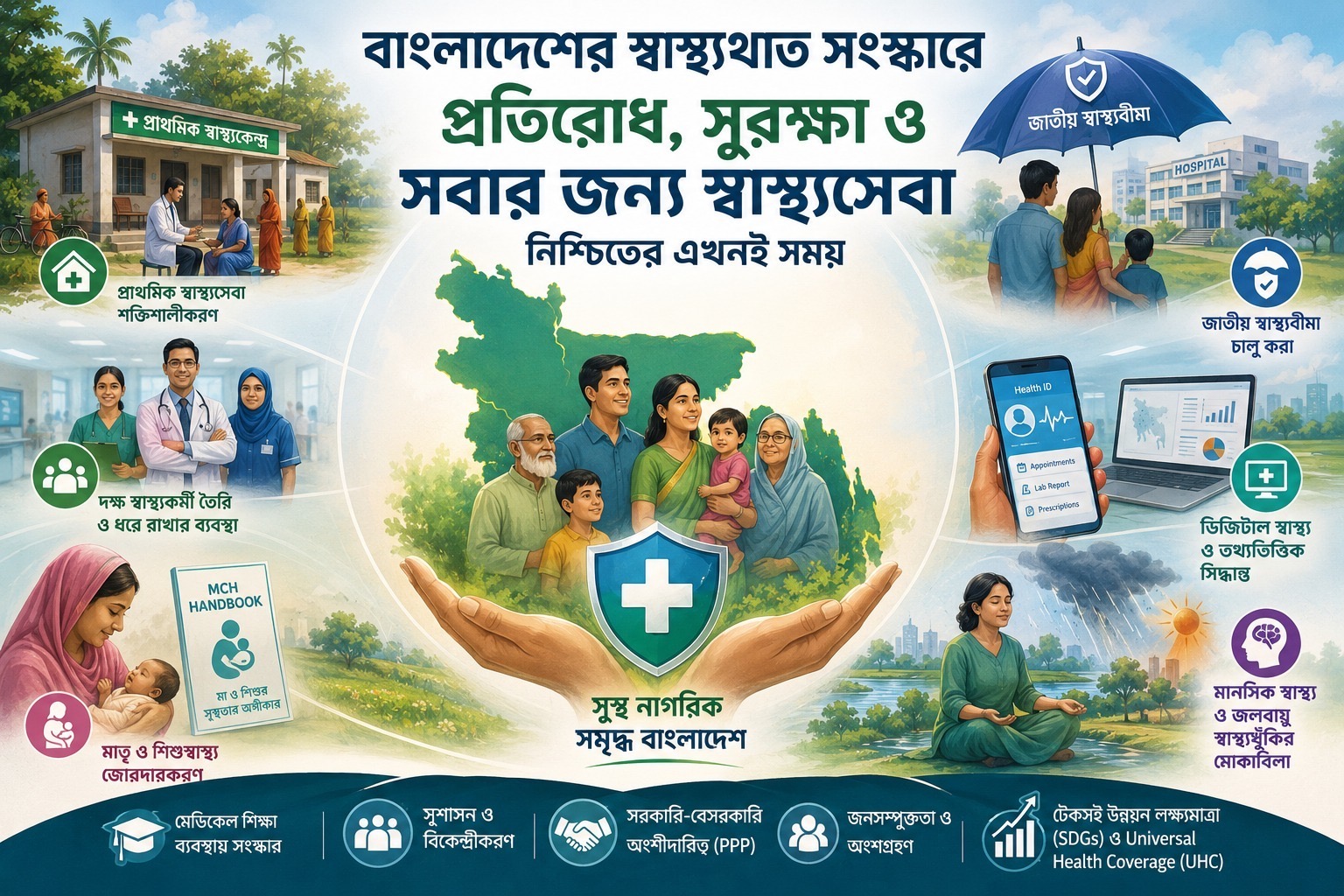
A new vision for healthcare reform is needed. Under the framework titled “Promoting, Preventing, and Protecting Health and Well-Being in Bangladesh,” several strategic priority areas were identified to help build a stronger, more inclusive, technology-driven, and sustainable healthcare system.
The core objective of this proposal was to help Bangladesh achieve the Sustainable Development Goals (SDGs) by 2030 and establish an effective Universal Health Coverage (UHC) system, ensuring that every citizen — regardless of income, geographic location, or social status — can access quality healthcare services.
Healthcare should not focus solely on treating illness. Protecting health, preventing disease, and ensuring overall well-being should become the foundation of the national health policy.
Why Healthcare Reform Is Urgently Needed
Unequal access to healthcare remains one of Bangladesh’s greatest challenges. Many people, particularly in remote regions, still lack timely access to quality medical services. Countless families face severe financial hardship because of healthcare expenses, highlighting the negative impact of high out-of-pocket health expenditures.
At the same time, non-communicable diseases such as diabetes, heart disease, hypertension, and cancer are rising rapidly. Mental health issues, an aging population, environmental pollution, and climate-related health threats are placing additional pressure on the healthcare system.
Considering these realities, a comprehensive, future-oriented, and citizen-centered healthcare reform roadmap has been proposed.
Key Priority Areas of the Proposal
1. Strengthening Primary Healthcare
Primary healthcare should become the foundation of Bangladesh’s healthcare system. This requires expanding rural health centers and satellite clinics, introducing telemedicine services, and improving the skills of community healthcare workers.
Patients should not have to travel to Dhaka for minor illnesses; quality treatment must be available at the local level.
2. Building and Retaining a Skilled Health Workforce
One of Bangladesh’s biggest challenges is ensuring an adequate number of qualified doctors, nurses, midwives, and public health professionals.
The proposal recommends:
Regular training and professional skill development for healthcare workers
Special incentives for serving in rural areas
Expanded opportunities for career advancement and leadership development
3. Strengthening Maternal and Child Health (MCH)
To build upon Bangladesh’s achievements, greater emphasis must be placed on Maternal and Child Health (MCH).
Recommendations include expanding safe delivery services, increasing the availability of skilled midwives, strengthening prenatal and postnatal care, and introducing family-based communication tools such as the MCH Handbook to improve coordinated healthcare for mothers and children.
4. Introducing National Health Insurance
A significant portion of healthcare expenses in Bangladesh is still paid directly by citizens, causing many families to fall into poverty due to medical costs.
An inclusive Universal Health Insurance system is therefore urgently needed, with government-subsidized premiums for low-income populations. Such a system would make healthcare more equitable and financially protective.
5. Digital Health and Data-Driven Decision Making
Modern healthcare systems must be information-driven. The proposal recommends establishing a centralized Health Informatics System capable of collecting real-time health data, enabling analysis and evidence-based policymaking.
6. Addressing Mental Health and Climate-Related Health Risks
Mental health remains neglected in Bangladesh, while floods, heatwaves, dengue outbreaks, and climate change-related health risks are increasing.
The proposal therefore emphasizes integrating mental health services into primary healthcare and developing climate-resilient health infrastructure.
Reforming Medical Education
Large-scale reform in medical education is also essential to build a stronger healthcare workforce.
In today’s rapidly changing world, future physicians must possess not only medical knowledge, but also communication skills, leadership abilities, ethical understanding, technological competence, research capacity, and expertise in community-based healthcare.
The proposal therefore calls for more practical clinical training, expanded research opportunities, and increased use of technology in both MBBS and postgraduate medical education. It also stresses the importance of ensuring equal standards between public and private medical institutions.
Good Governance Is Essential
Ultimately, meaningful healthcare reform is impossible without good governance.
To build an effective healthcare system in Bangladesh, it is essential to strengthen decentralized health administration, reduce corruption, encourage public-private partnerships (PPP), and ensure participatory decision-making involving local communities.
Healthcare must be elevated above partisan politics and treated as a national development priority.
The Time for Bold Healthcare Reform Is Now
If Bangladesh truly wants to achieve “Health for All,” it must build an integrated, technology-driven, prevention-focused, patient-centered, and sustainable healthcare system.
If implemented effectively, these proposed reforms could create a major policy shift in Bangladesh’s healthcare sector — one that would not only improve healthcare quality, but also help build a healthier, more productive, and more humane nation.
Because ultimately, healthcare is not merely about treatment — it is the foundation of a nation’s human capital, economic progress, and social justice.