

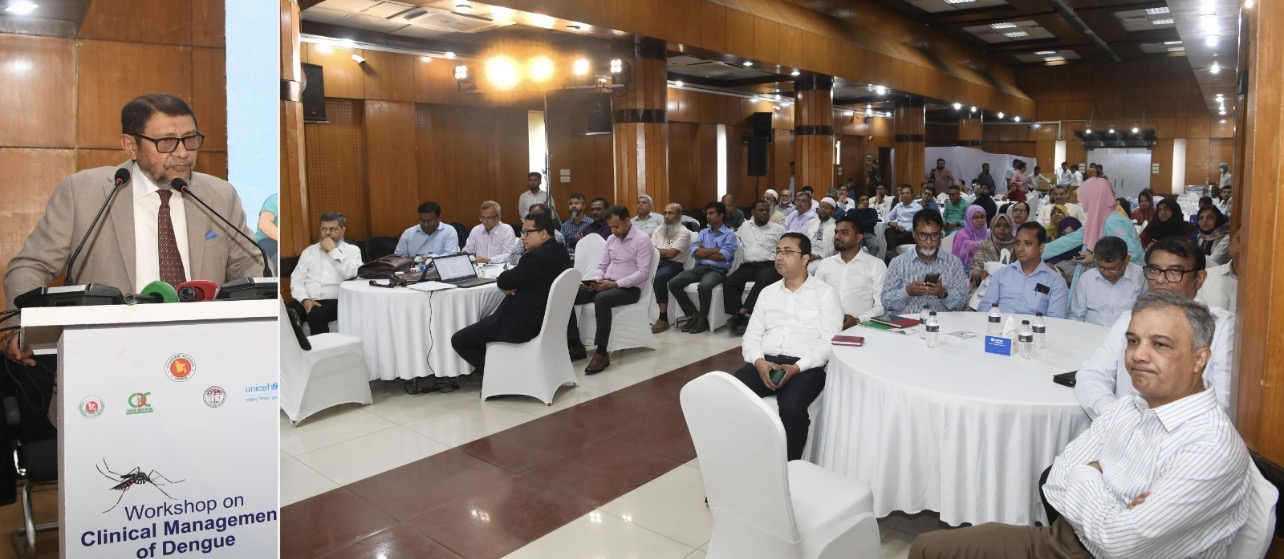
DHAKA, June 7: — A national Training of Trainers (ToT) program on the clinical management of dengue was officially inaugurated today at Shahid Dr. Milon Hall of Bangladesh Medical University in Dhaka. The program is being implemented by the Ministry of Health and Family Welfare in collaboration with UNICEF Bangladesh and the Bangladesh Society of Medicine.
The inaugural session was attended as chief guest by Health and Family Welfare Minister Sardar Md. Sakhawat Hossain.
Speaking at the event, the Health Minister said dengue has evolved from a common disease into a major national public health challenge. He emphasized that addressing this crisis is not solely the responsibility of the Ministry of Health or hospitals, but requires the active participation of every citizen.
“I can pressure city corporations and district administrations to carry out cleaning drives. But I cannot guarantee that 100 percent of mosquitoes or larvae will be eliminated,” he said. “Mosquitoes can fly up to 200 meters and enter homes through any small opening. Therefore, this is an extremely difficult battle.”
Describing the situation as a “total fight,” the minister stressed that victory against dengue is impossible without cleaning all drains, ditches, stagnant water bodies, and water hyacinth–infested areas across the country. He said no single institution or individual can manage this crisis alone; a coordinated national effort is essential.
Referring to dengue vaccination, the minister said immunization is under consideration but remains highly expensive and logistically challenging. He noted that large-scale vaccination would require a significant budget, and repeated doses every four months could place a heavy burden on the national health budget. Therefore, he emphasized prevention over treatment.
Explaining the spread of dengue, he said stagnant rainwater in small urban and rural spaces—such as water collected in garages after car washing, abandoned tires, unused cans, roadside potholes, and dirty water in large drains and canals—creates widespread breeding grounds for Aedes mosquitoes.
The minister further stated that achieving 100 percent prevention is extremely difficult; therefore, equal importance must be given to ensuring proper treatment. He urged physicians to focus on early detection of plasma leakage, which is critical in managing severe dengue cases, and to closely monitor patients for signs of deterioration.
He also said that doctors are being trained under the guidance of the Society of Medicine to follow standardized treatment protocols. He called for these modern clinical practices to be extended to district and upazila-level healthcare providers and confirmed that the government is working to ensure the availability of necessary medical supplies for dengue treatment.
Among the distinguished guests were Vice-Chancellor of Bangladesh Medical University Professor Dr. F. M. Siddiqi, who stressed the importance of continuous monitoring of dengue patients through regular CBC tests and plasma leakage assessment to prevent shock and life-threatening complications.
Professor Dr. Mohammad Moniruzzaman, Convener of the Bangladesh Society of Medicine, said that dengue management is now shifting from a reactive approach to a proactive strategy, focusing on prevention before the situation worsens.
UNICEF Bangladesh Health Manager Dr. Riad Mahmud attended as a special guest, while the overall coordination was carried out by Professor Dr. Halimur Rashid, Director of Disease Control at the Directorate General of Health Services. Director General Professor Dr. Prabhat Chandra Biswas also addressed the program.
According to official data presented at the event, Bangladesh recorded 321,179 dengue cases and 1,705 deaths in 2023; 101,214 cases and 575 deaths in 2024; and 102,861 cases and 413 deaths in 2025—confirming that dengue has become a year-round public health crisis in the country.
Officials said the training initiative is part of a structured three-month national dengue prevention and control program led by the Ministry of Health and Family Welfare. The initiative represents a foundational step in strengthening clinical preparedness and national response capacity for 2026.
Following this first batch of training, healthcare professionals from private medical colleges and corporate hospitals will also be included. Subsequent sessions will be conducted at divisional and district levels to ensure evidence-based dengue management is implemented across all tiers of the healthcare system.